Under Graduate Programmes:

B.Tech CSE with Artificial Intelligence & Machine Learning:

AI is a bigger concept to create intelligent machines that can simulate human thinking capability and behavior, whereas, machine learning is an application or subset of AI that allows machines to learn from data without being programmed explicitly. Machine learning is a subfield of artificial intelligence, which enables machines to learn from past data or experiences without being explicitly programmed. AI is everywhere, from gaming stations to maintaining complex information at work. Computer Engineers and Scientists are working hard to impart intelligent behavior in the machines making them think and respond to real-time situations. AI is transiting from just a research topic to the early stages of enterprise adoption.

Scope

Machine games, speech recognition, language detection, computer vision, expert systems, robotics, and other fields have potential. The more you understand machine learning sciences, such as physics or biology, the better. AI includes jobs in intelligence, game programmers, robotic scientists, computer scientists, and data scientists among others. Artificial Intelligence is, thus, a very popular course worldwide. It is beneficial to master at least one basic machine language in order to work in this field.


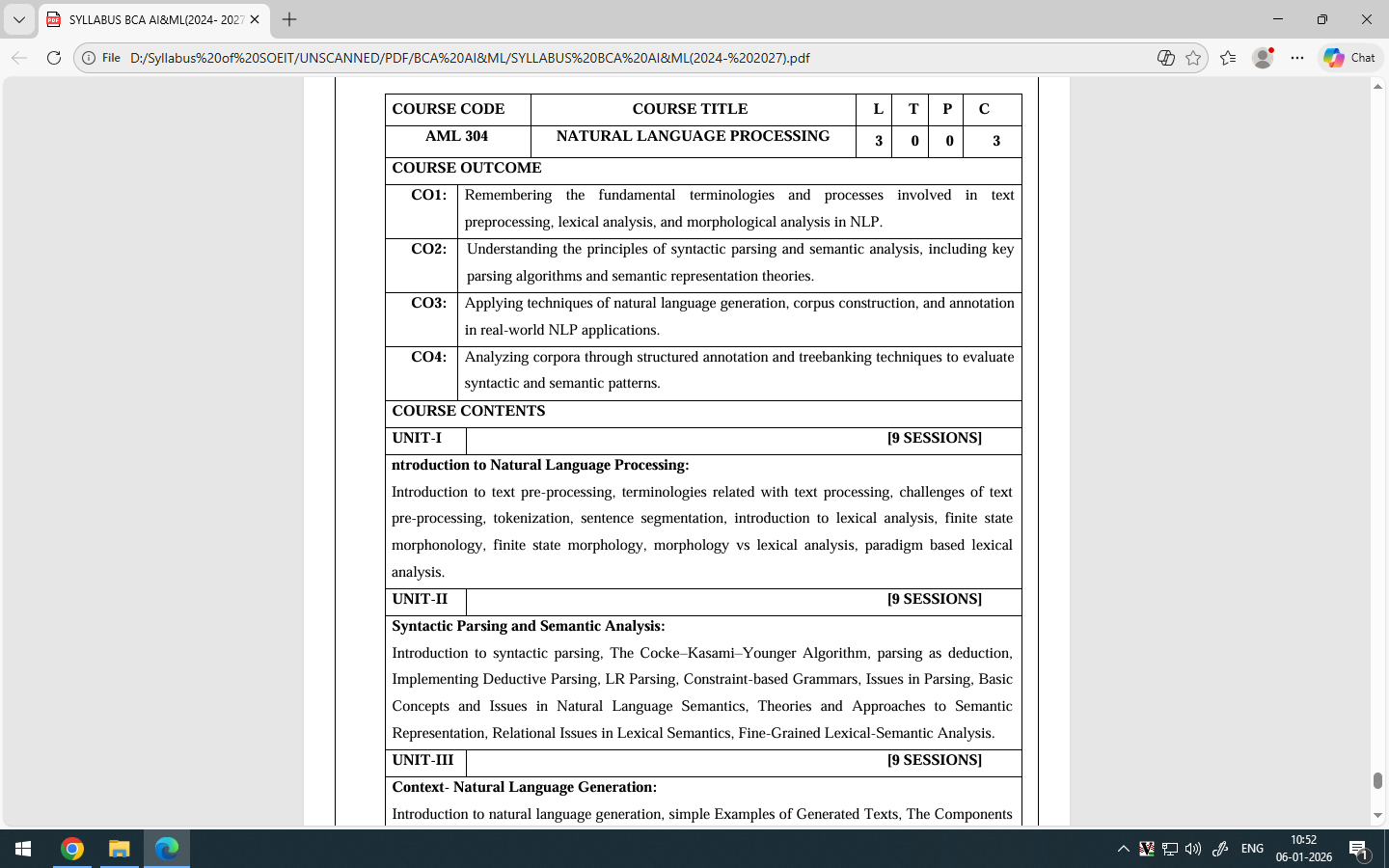
This course provides a comprehensive introduction to Natural Language Processing (NLP), a key area of Artificial Intelligence that focuses on enabling computers to understand, interpret, and generate human language. The course covers fundamental concepts of linguistics, text processing, and language modeling, along with core NLP techniques such as tokenization, stemming, part-of-speech tagging, syntactic and semantic analysis.

Students will learn classical and modern approaches to NLP, including rule-based methods, statistical models, machine learning, and deep learning techniques. The course also introduces advanced topics such as word embeddings, sequence models, transformers, and large language models. Practical exposure is provided through hands-on experiments using NLP libraries and tools to solve real-world problems like sentiment analysis, text classification, machine translation, and chatbots.

By the end of the course, learners will be able to analyze natural language data, design and implement NLP pipelines, and apply appropriate models for various language processing applications across domains such as healthcare, finance, education, and social media.