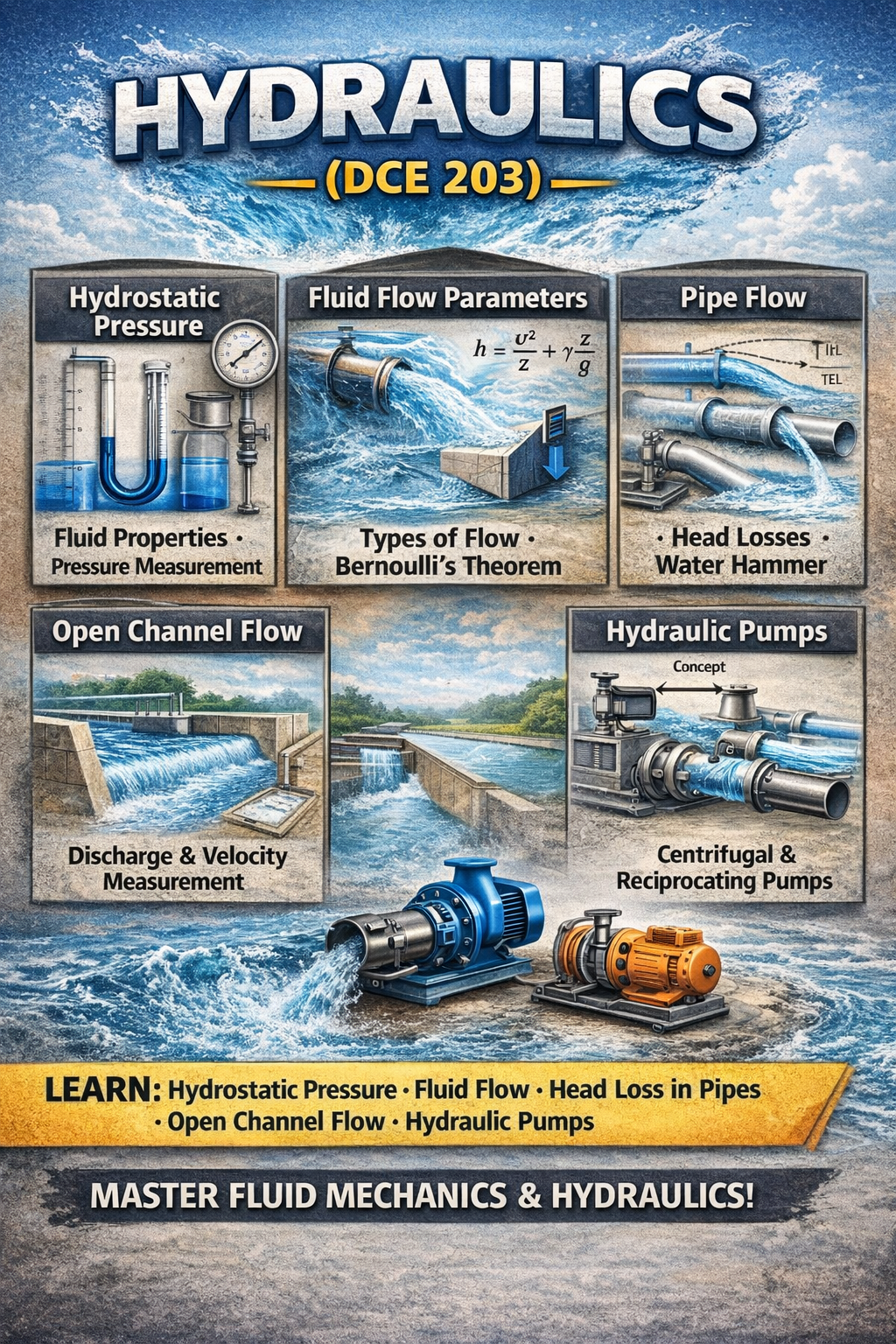
Hydraulics (DCE 203)
This course focuses on the fundamentals of fluid mechanics and hydraulics, helping students understand how fluids behave at rest and in motion.
It begins with hydrostatic pressure, covering fluid properties, different types of pressure, and methods of pressure measurement. Students also learn how pressure varies with depth and how to calculate total pressure and centre of pressure.
The course then explains fluid flow parameters, including types of flow, discharge, energy of flowing fluids, and the application of Bernoulli’s theorem.
In pipe flow, students study major and minor head losses, flow through pipes in series and parallel, and concepts like hydraulic gradient line (HGL) and total energy line (TEL). Important phenomena such as water hammer and devices used for measuring discharge are also included.
The course also covers open channel flow, including channel properties, velocity and discharge measurement, and specific energy concepts.
Finally, students learn about hydraulic pumps, including types, working principles of centrifugal and reciprocating pumps, and concepts like suction head, delivery head, and pump selection.
Overall Learning Outcomes
After completing this course, students will be able to:
- Measure and analyze fluid pressure
- Understand fluid flow behavior
- Calculate head losses in pipes
- Analyze flow in open channels
- Select suitable pumps for different applications
- Teacher: RADHA TOMAR

Computer network
A computer network is a system of interconnected computing devices—such as computers, servers, and mobile devices
—that communicate and share resources using protocols over physical or wireless connections.
They facilitate data sharing, internet access, and communication, forming the backbone of modern digital infrastructure.
- Study the basic taxonomy and terminology of the computer networking and enumerate the layers of OSI model and TCP/IP model.
- Acquire knowledge of Application layer and Presentation layer paradigms and protocols.
- Study Session layer design issues, Transport layer services, and protocols.
- Gain core knowledge of Network layer routing protocols and IP addressing.Study data link layer concepts, design issues, and protocol
- Read the fundamentals and basics of Physical layer, and will apply them in real time applications.
 Cover.jpg
Software is a program or set of programs containing instructions that provide the desired functionality. Engineering is the process of designing and building something that serves a purpose efficiently and cost-effectively.
Explain various so ware characteristics and analyze different so ware Development Models.
Demonstrate the contents of a SRS and apply
basic so ware quality assurance practices to ensure that design, development
meet or exceed applicable standards.
Compare and contrast various methods for software
design.
Formulate testing
strategy for so ware systems, employ techniques such as unit testing, Test
driven development and functional testing.
Manage so ware development process independently
as well as in teams and make use of various so ware management tools for
development, maintenance and analysis.
Explain various so ware characteristics and analyze different so ware Development Models.
Demonstrate the contents of a SRS and apply
basic so ware quality assurance practices to ensure that design, development
meet or exceed applicable standards.
Compare and contrast various methods for software design.
Formulate testing strategy for so ware systems, employ techniques such as unit testing, Test driven development and functional testing.
Manage so ware development process independently
as well as in teams and make use of various so ware management tools for
development, maintenance and analysis.
- Teacher: Harsh Verma
An Operating System (OS) is an interface between a computer user and computer hardware. An operating system is a software which performs all the basic tasks like file management, memory management, process management, handling input and output, and controlling peripheral devices such as disk drives and printers.
- Explaining the fundamental concepts of operating systems, including Linux/UNIX architecture, kernel, system calls, and system programs.
- Applying process management techniques such as process creation, IPC, multithreading, scheduling, and memory management methods like paging, segmentation, and virtual memory.
- Analyzing file systems, directory structures, I/O management, disk scheduling algorithms, RAID levels, and OS security mechanisms such as authentication and access control.
- Demonstrating the ability to work with different file systems, perform file operations, and evaluate system performance related to storage and I/O.
- Evaluating operating system security issues and apply appropriate mechanisms such as authentication, access rights, and system logging to ensure system protection.
- Explaining the fundamental concepts of operating systems, including Linux/UNIX architecture, kernel, system calls, and system programs.
- Applying process management techniques such as process creation, IPC, multithreading, scheduling, and memory management methods like paging, segmentation, and virtual memory.
- Analyzing file systems, directory structures, I/O management, disk scheduling algorithms, RAID levels, and OS security mechanisms such as authentication and access control.
- Demonstrating the ability to work with different file systems, perform file operations, and evaluate system performance related to storage and I/O.
- Evaluating operating system security issues and apply appropriate mechanisms such as authentication, access rights, and system logging to ensure system protection.
- Teacher: Harsh Verma