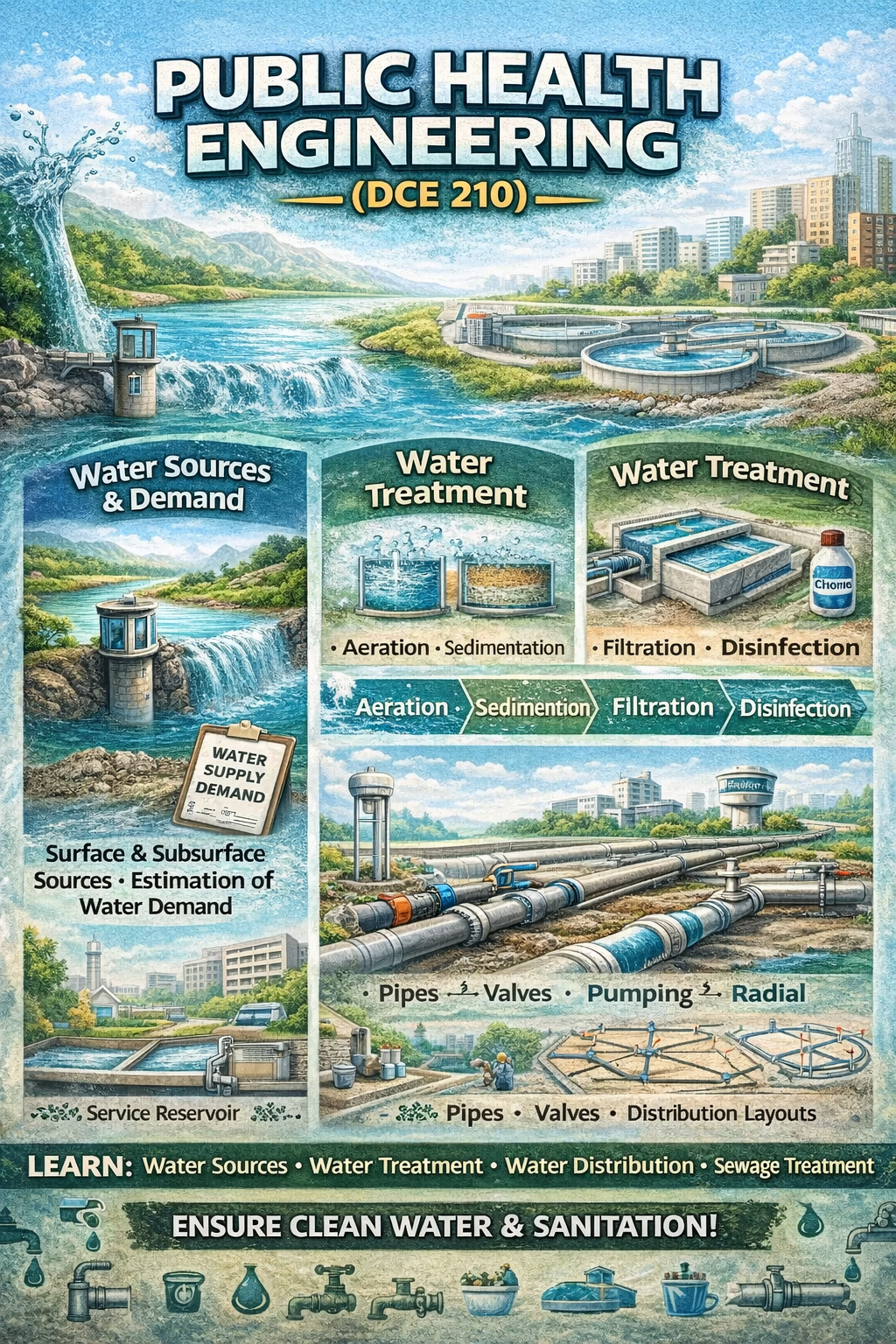
Public Health Engineering (DCE 210)
This course deals with the planning, design, and management of water supply and sanitation systems to ensure public health and hygiene.
It starts with the sources of water (surface and subsurface), intake structures, and factors affecting their location. Students learn how to estimate water demand, forecast population, and determine the required quantity of water for a city. It also covers water quality analysis, including physical, chemical, and biological characteristics as per IS 10500 standards.
The course then explains water treatment processes such as aeration, sedimentation, coagulation, filtration, and disinfection (chlorination). It also includes advanced treatments like water softening and defluorination.
Further, students study water conveyance and distribution systems, including types of pipes, valves, joints, and different distribution layouts like dead-end, grid iron, and radial systems.
The course also focuses on sanitation and sewerage systems, covering domestic sewage, plumbing systems, sanitary fittings, traps, and sewer components like manholes and inlets.
Finally, it deals with sewage treatment, including analysis (BOD, COD), treatment methods (aerobic and anaerobic), and disposal techniques like septic tanks, oxidation ponds, and reuse of wastewater
Overall Learning Outcomes
After completing this course, students will be able to:
- Identify and select suitable water sources
- Estimate water demand for a population
- Design basic water supply systems
- Understand sanitation and sewerage systems
- Apply sewage treatment methods for safe disposal
- Teacher: RADHA TOMAR
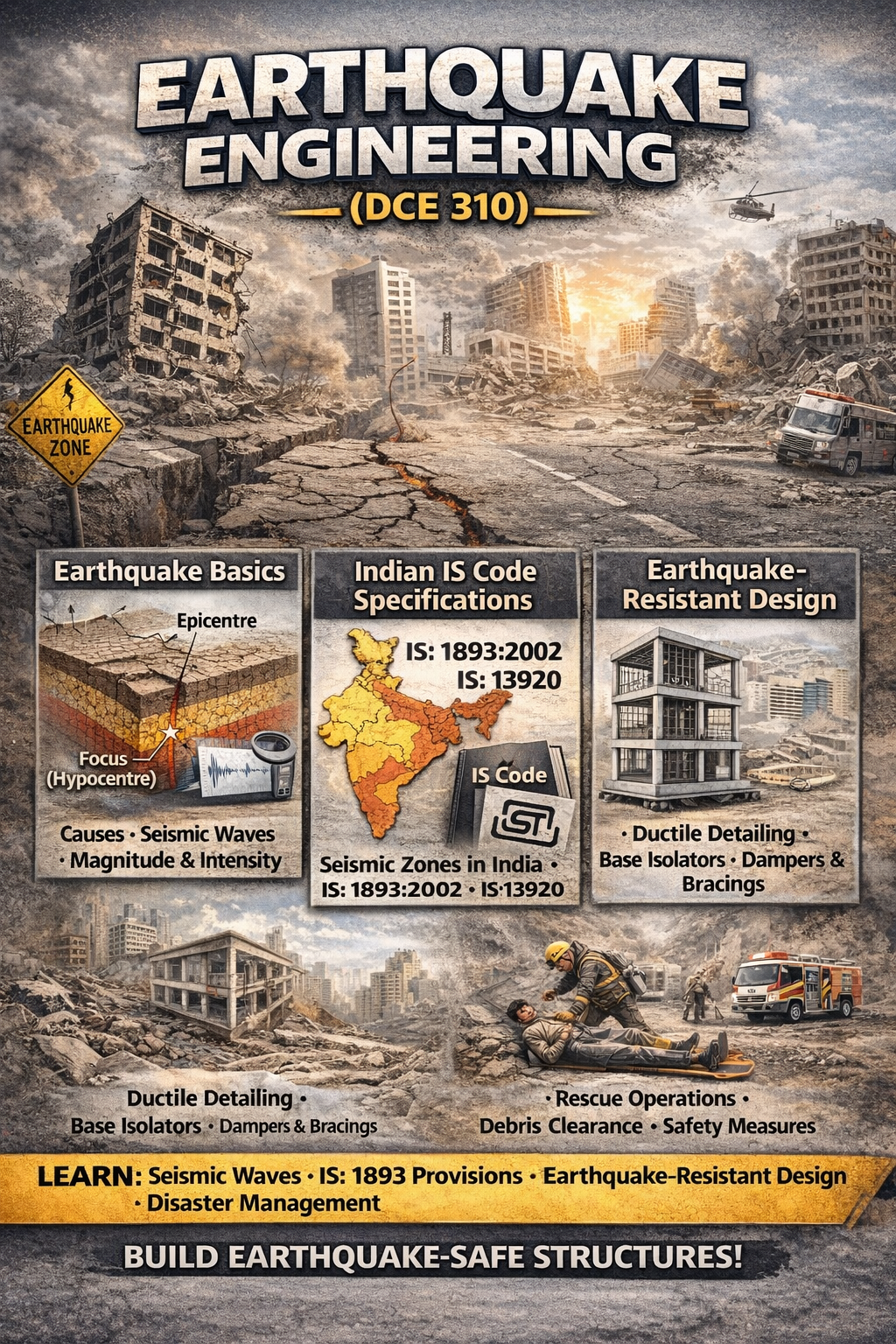
Earthquake Engineering (DCE 310)
This course focuses on understanding earthquakes and designing structures that can safely resist seismic forces. It provides both theoretical knowledge and practical guidelines for earthquake-resistant construction.
The course begins with the basic concepts of earthquakes, including causes, epicentre, hypocentre, and different types of seismic waves (P, S, and surface waves). It also explains magnitude, intensity, and seismic zones in India, along with the performance of buildings during past earthquakes.
Students then study important Indian Standard codes, especially IS: 1893:2002, along with an introduction to IS: 13920 (ductile detailing) and IS: 4326 (earthquake-resistant masonry construction).
The course also covers special construction techniques and precautions required for planning, designing, and constructing earthquake-resistant buildings.
Finally, it includes disaster management, focusing on rescue operations, planning, safety measures, equipment, and handling post-earthquake situations like debris clearance.
Overall Learning Outcomes
After completing this course, students will be able to:
- Understand earthquake phenomena and seismic behavior
- Analyze seismic waves and earthquake intensity
- Apply IS code provisions in design
- Plan and construct earthquake-resistant structures
- Manage disaster and rescue operations effectively
- Teacher: RADHA TOMAR
Internet of Things
The Internet of Things (IoT) connects physical devices—like sensors, appliances, and wearables—to the internet, allowing them to exchange data, automate tasks, and be controlled remotely. For students, IoT offers hands-on STEM learning, enabling the creation of smart projects (e.g., automated lights, smart homes) that boost programming and engineering skills
- Understand the fundamentals of IoT
including its evolution, ecosystem, features, benefits, and applications.
- Explain IoT architectures, communication
models, and networking technologies used in IoT systems.Describe
- IoT communication protocols,
sensors, actuators, M2M communication, and the role of cloud computing in IoT.
- Analyze IoT security issues, privacy
concerns, data management challenges, and major IoT application domains
- Evaluate future IoT trends including AI and ML
integration, edge and fog computing, blockchain, digital twins, and advanced
IoT applications.
- Teacher: Abhishek .