Introduction to Computers, Anatomy of Computers, Memory Concepts, Units of Memory, Operating System: Definition and types, Applications of MS-Office forcreating, Editing and Formatting a document, Data presentation, Tabulation and graph creation, Statisticalanalysis,Mathematicalexpressions, Database,concepts and types,creating database, Uses of DBM Sin Agriculture, Internet and World Wide Web (WWW): Concepts and components. Computer programming: General concepts, Introduction to Visual Basic, Java, Fortran, C/ C++, etc. concepts and standard input/ output operations.e-Agriculture, Concepts, design and development, Application of innovative ways to use information and communication technologies (IT) in Agriculture, Computer Models in Agriculture: Statistical, weather analysis and crop simulation models, concepts, structure, inputs-outputs files, limitation, advantages and application of models for understanding plant processes, sensitivity, verification, calibration and validation, IT applications for computation of water and nutrient requirement of crops, Computer-controlled devices (automated systems) for Agri-input management, Smart phone mobile apps in agriculture for farm advice: Market price, post harvest management etc.,Geospatial technology: Concepts, techniques, components and uses for generating valuable agri-information, Decision support systems: Concepts, components and applications in Agriculture, Agriculture Expert System ,Soil Information Systemsetc .for supporting farm decisions. Preparation of contingent crop-planning and crop calendars using IT tools, Digital India and schemes to promote digitalization of agriculture in India.
- Teacher: Ashish Tiwari
Course Outcome
CO 1. Understanding the principles of economics and to get an idea of macro and micro economics.
CO 2. Assessing broad areas covered under agricultural Economics and farm management.
CO 3. Evaluating the profitable level of inputs use in a farm production process.
CO 4. Applying the concept of agricultural economics and its relation with other subjects.
Theory:
Economics: Meaning, scope and subject matter, definitions, activities, approaches to economic analysis; micro and macro economics, positive and normative analysis. Nature of economic theory; rationality assumption, concept of equilibrium, economic laws as generalization of human behavior. Basic concepts: Goods and services, desire, want, demand, utility, cost and price, wealth, capital, income and welfare. Agricultural economics: meaning, definition, characteristics of agriculture, importance and its role in economic development. Agricultural planning and development in the country.Demand: meaning, law of demand, demand schedule and demand curve, determinants, utility theory; law of diminishing marginal utility, equi- marginal utility principle. Consumer’s equilibrium and derivation of demand curve, concept of consumer surplus. Elasticity of demand: concept and measurement of price elasticity, income elasticity and cross elasticity. Production: process, creation of utility, factors of production, input output relationship. Laws of returns: Law of variable proportions and law of returns to scale. Cost: Cost concepts, short run and long run cost curves. Supply: Stock v/s supply, law of supply, supply schedule, supply curve, determinants of supply, elasticity of supply. Distribution theory: meaning, factor market and pricing of factors of production. Concepts of rent, wage, interest and profit. National income: Meaning and importance, circular flow, concepts of national income accounting and approaches to measurement, difficulties in measurement. Population: Importance, Malthusian and Optimum population theories, natural and socio-economic determinants, current policies and programmes on population control. Money: Barter system of exchange and its problems, evolution, meaning and functions of money, classification of money, money supply, general price index, inflation and deflation. Economic systems: Concepts of economy and its functions, important features of capitalistic, socialistic and mixed economies, elements of economic planning. Forms of business organizations, international trade and balance of payments.GST and its implication on Indian economy.
- Teacher: Twinkle Thapa
CO 1. Understanding about IPR, patent and Plant Breeders & Farmers Rights.
CO 2. Understanding the diversity, inheritance and variation in crops.
CO 3. Evaluating the different breeding methods in asexually propagated, self and cross pollinated crops.
CO 4. Applying the different breeding techniques for crop improvement.
Historical development, concept, nature and role of plant breeding, major achievements and future prospects; Genetics in rlation to plant breeding, modes of reproduction and apomixes, self-incompatibility and male-sterility-genetic consequences, cultivar options, Domestication, Acclimatization and Introduction; Centres of origin/diversity, Components of Genetic variation; Heritability and genetic advance; Genetic basis and breeding methods in self pollinated crops-mass and pure line selection, hybridization techniques and handling of segregating population; Multiline concept, Concepts of population genetics and Hardy-Weinberg Law, Genetic basis and methods of breeding cross-pollinated crops, modes of selection; Population movement schemes- Ear to Row method, Modified Ear to Row, recurrent selection schemes; Heterosis and inbreeding depression, development of inbred lines and hybrids, composite and synthetic varieties; Breeding methods in asexually propagated crops, clonal selection and hybridization; Maintenance of breeding records and data collection; Wide hybridization and pre-breeding; Polyploidy in relation to plant breeding, mutation breeding- methods and uses; Breeding for important biotic and abiotic stresses; Biotechnological tools-DNA markers and marker assisted selection. Participatory plant breeding; Intellectual Propert Rights, Patenting, Plant Breeders & Farmer’s Rights.
- Teacher: Vikas Gautam
Course Outcome
CO 1. Understanding about the different forms of classification of vegetables
CO 2. Understanding the origin, area, climate, soil, improved varieties and cultivation practices of vegetables and spices.
CO 3. Assessing the physiological disorders of vegetables and spices
CO 4. Applying the knowledge on basic production technology
Theory
Importance of vegetables & spices in human nutrition and national economy, kitchen gardening, brief about origin, area, climate, soil , improved varieties and cultivation practices such as time of sowing, transplanting techniques, planting distance, fertilizer requirements, irrigation, weed management, harvesting and yield, physiological disorders, of important vegetable and spices (Tomato, Brinjal, Chili, Capsicum, Cucumber, Melons, Gourds, Pumpkin ,French bean, Peas; Cole crops such as Cabbage, Culiflower, Knol-Khol; Bulb crops such as Onion, Garlic; Root crops such as Carrot, Raddish, Beetroot; Tuber crops such as Potato; Leafy vegetables such as Amaranth, Palak, Perennial vegetables).- Teacher: Akash Shukla
Course Outcome:
- CO 1: Understanding the various farm implements and equipment’s.
- CO 2: Understanding the application of implements for various operations.
- CO 3: Evaluating the different systems of I.C. engines.
- CO 4: Applying technical know-how on working of equipment’s.
Theory:
Status of Farm Power in India, Sources of Farm Power , I.C. engines, working principles of I C engines, comparison of two stroke and four stroke cycle engines , Study of different components of I.C. engine, I.C. engine terminology and solved problems, Familiarization with different systems of I.C. engines: Air cleaning, cooling, lubrication, fuel supply and hydraulic control system of a tractor, Familiarization with Power transmission system : clutch, gear box, differential and final drive of a tractor , Tractor types, Cost analysis of tractor power and attached implement, Criteria for selection of tractor and machine implements. Familiarization with Primary and Secondary Tillage implement, Implement for hill agriculture, implement for intercultural operations, Familiarization with sowing and planting equipment, calibration of a seed drill and solved examples, Familiarization with Plant Protection equipment, Familiarization with harvesting and threshing equipment.
- Teacher: Ajay Kumar Baheliya
|
COURSE CODE |
COURSE TITLE |
L |
P |
C |
|
BSA 217 |
LIVESTOCK AND POULTRY MANAGEMENT |
1 |
1 |
2 |
Course Outcomes
CO 1. Understanding the importance of farm animals
CO 2. Understanding the management of farm animals, its nutrient requirement and its housing.
CO 3. Analyzing characteristics of indigenous and exotic breeds of cattle, goat, buffalo, swine and poultry and their management.
CO 4. Evaluating the Practical knowledge on management of farm animals can be well addressed.
Theory
Role of livestock in the national economy. Reproduction in farm animals and poultry. Housing principles, space requirements for different species of livestock and poultry. Management of calves, growing heifers and milch animals. Management of sheep, goat and swine. Incubation, hatching and brooding. Management of growers and layers. Important Indian and exotic breeds of cattle, buffalo, sheep, goat, swine and poultry. Improvement of farm animals and poultry. Digestion in livestock and poultry. Classification of feedstuffs. Proximate principles of feed. Nutrients and their functions. Feed ingredients for ration for livestock and poultry. Feed supplements and feed additives. Feeding of livestock and poultry. Introduction of livestock and poultry diseases. Prevention (including vaccination schedule) and control of important diseases of livestock and poultry.
|
UNIT |
TOPICS TO BE COVERED |
LECTURES REQUIRED |
|
UNIT - 1 |
Role of livestock in the national economy. Reproduction in farm animals and poultry. Housing principles, space requirements for different species of livestock and poultry. |
5 |
|
UNIT - 2 |
Management of calves, growing heifers and milch animals. Management of sheep, goat and swine. Incubation, hatching and brooding. |
5 |
|
UNIT - 3 |
Management of growers and layers. Important Indian and exotic breeds of cattle, buffalo, sheep, goat, swine and poultry. Improvement of farm animals and poultry. Digestion in livestock and poultry. |
5 |
|
UNIT - 4 |
Classification of feedstuffs. Proximate principles of feed. Nutrients and their functions. Feed ingredients for ration for livestock and poultry. Feed supplements and feed additives. Feeding of livestock and poultry. Introduction of livestock and poultry diseases. |
5 |
|
UNIT - 5 |
Prevention (including vaccination schedule) and control of important diseases of livestock and poultry. |
5 |
Practical
External body parts of cattle, buffalo, sheep, goat, swine and poultry. Handling and restraining of livestock. Identification methods of farm animals and poultry. Visit to IDF and IPF to study breeds of livestock and poultry and daily routine farm operations and farm records. Judging of cattle, buffalo and poultry. Culling of livestock and poultry. Planning and layout of housing for different types of livestock. Computation of rations for livestock. Formulation of concentrate mixtures. Clean milk production, milking methods. Hatchery operations, incubation and hatching equipments. Management of chicks, growers and layers. Debeaking, dusting and vaccination. Economics of cattle, buffalo, sheep, goat, swine and poultry production
|
UNIT |
EXERCISE |
LECTURES REQUIRED |
|
EXERCISE- 1 |
External body parts of cattle, buffalo, sheep, goat, swine and poultry. Handling and restraining of livestock. Identification methods of farm animals and poultry |
2 |
|
EXERCISE- 2 |
Visit to IDF and IPF to study breeds of livestock and poultry and daily routine farm operations and farm records. Judging of cattle, buffalo and poultry. |
2 |
|
EXERCISE- 3 |
Culling of livestock and poultry. Planning and layout of housing for different types of livestock. Computation of rations for livestock. |
2 |
|
EXERCISE- 4 |
Formulation of concentrate mixtures. Clean milk production, milking methods. Hatchery operations, incubation and hatching equipments. |
2 |
|
EXERCISE- 5 |
Management of chicks, growers and layers. Debeaking, dusting and vaccination. Economics of cattle, buffalo, sheep, goat, swine and poultry production |
2 |
Suggested readings:
1. A Textbook of Animal Husbandry by G. C Banerjee
1. A text Book of Livestock Production management in Tropic by D. N. Verma
- Teacher: Satish Chand
Course Outcome
CO 1. Understanding rain fed agriculture and watershed farming.
CO 2. Understanding Drought: types, effect of water deficit on physio-morphological characteristics of the plants will be known.
CO 3. Analyzing soil & moisture conservation measures can be known.
CO 4. Evaluating the efficient utilization of water through soil & crop management practices.
UNIT – I
Irrigation: definition and objectives, importance and functions of water for plant growth, water resources and irrigation development for different crops in India; soil–plant–water relationships; available and unavailable soil moisture, distribution of soil moisture, water budgeting, rooting characteristics, moisture extraction pattern, effect of moisture stress on crop growth.
UNIT – II
Methods of soil moisture estimation, evapotranspiration and crop water requirement; effective rainfall; different approaches of scheduling irrigation; methods of irrigation – surface and sub-surface, pressurized methods viz., sprinkler and drip irrigation; suitability, merits and limitations; fertigation and economic use of irrigation water.
UNIT – III
Layout of different irrigation systems; irrigation efficiency and water use efficiency; conjunctive use of water; irrigation water quality and its management; water management of crops (rice, wheat, maize, groundnut, sugarcane, mango, banana and tomato); agricultural drainage.
UNIT – IV
Water management problems; soil quality and irrigation water quality; irrigation management practices for different soils and crops; drip and sprinkler irrigation; layout of underground pipeline system.
- Teacher: Naveen Kumar Maurya
Course Outcome:
CO 1: Understanding the basics of Rabi crop production
CO 2: Assessing the economic importance of Rabi crop
CO 3: Analyzing the importance of aromatic crops & forage crops.
CO 4: Evaluating the Economic importance of Rabi crops and market value.
COURSE AND UNIT DETAILS
UNIT – I
Origin, geographical distribution, economic importance, soil and climatic requirements, varieties, cultural practices and yield of Rabi crops.
UNIT – II
Cereals – wheat and barley; pulses – chickpea, lentil, peas; oilseeds – rapeseed, mustard and sunflower.
UNIT – III
Sugar crops – sugarcane; medicinal and aromatic crops – mentha, lemongrass and citronella.
UNIT – IV
Forage crops – berseem, lucerne and oat.
- Teacher: Naveen Kumar Maurya
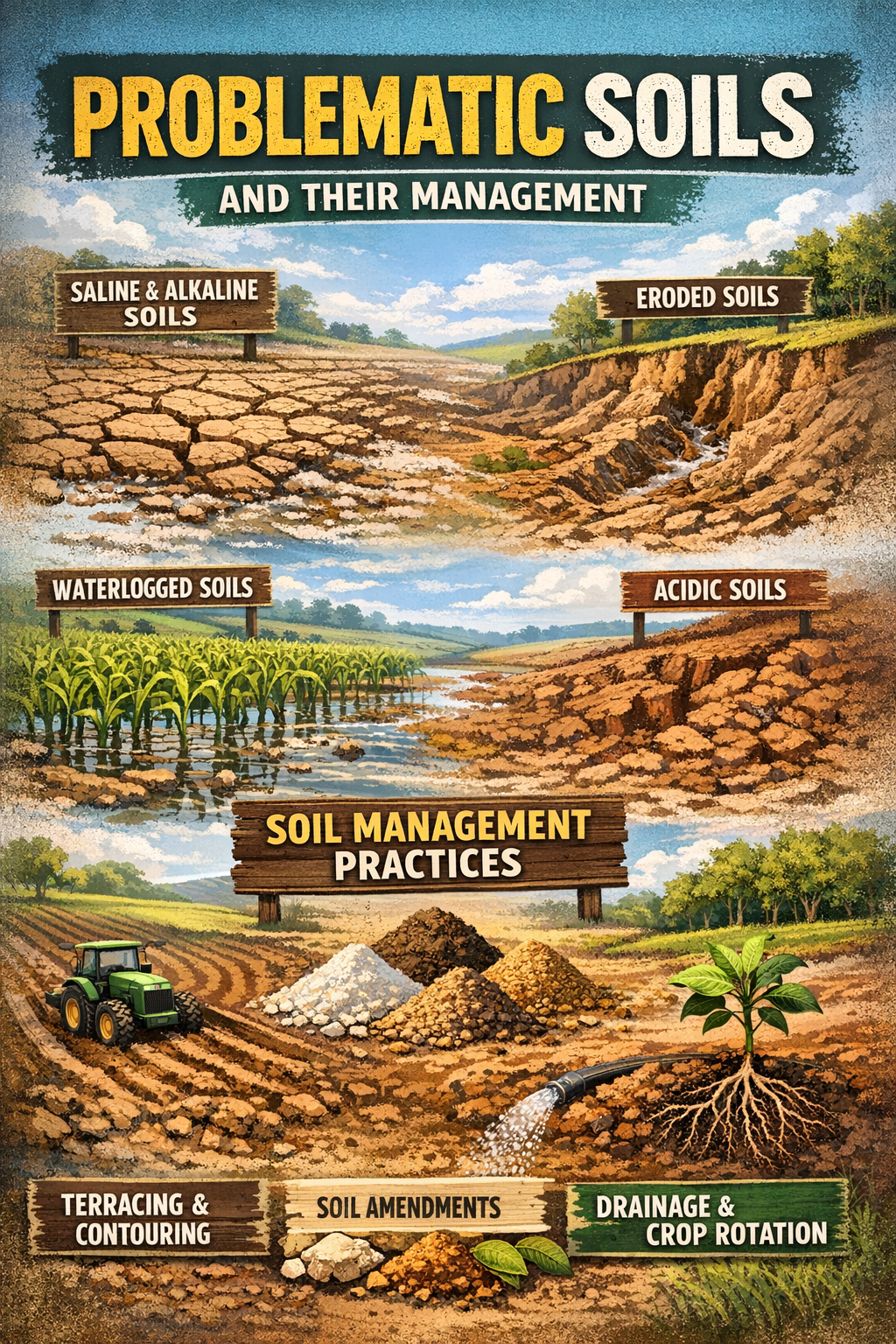
Soil quality and health, Distribution of Waste land and problem soils in India with special reference to Assam and North Eastern Region. Categorization of Problem soils based on properties. Reclamation and management of Acid soils, Saline, Sodic soils, Acid Sulphate soils, Eroded and Compacted soils, polluted soils. Management of Riverine soils, Waterlogged soils, Contaminated soils (Pesticide contamination, Heavy metal contamination), Mined soils (Coal mined, Oil mined), Irrigation water – quality and standards, utilization of saline water in agriculture. Use of Remote sensing and GIS in diagnosis and management of problem soils. Irrigation and water quality. Multipurpose tree (MPT) species, bio remediation through MPTs of soils, land capability and classification, land suitability classification.
- Teacher: Ajay Kumar Baheliya