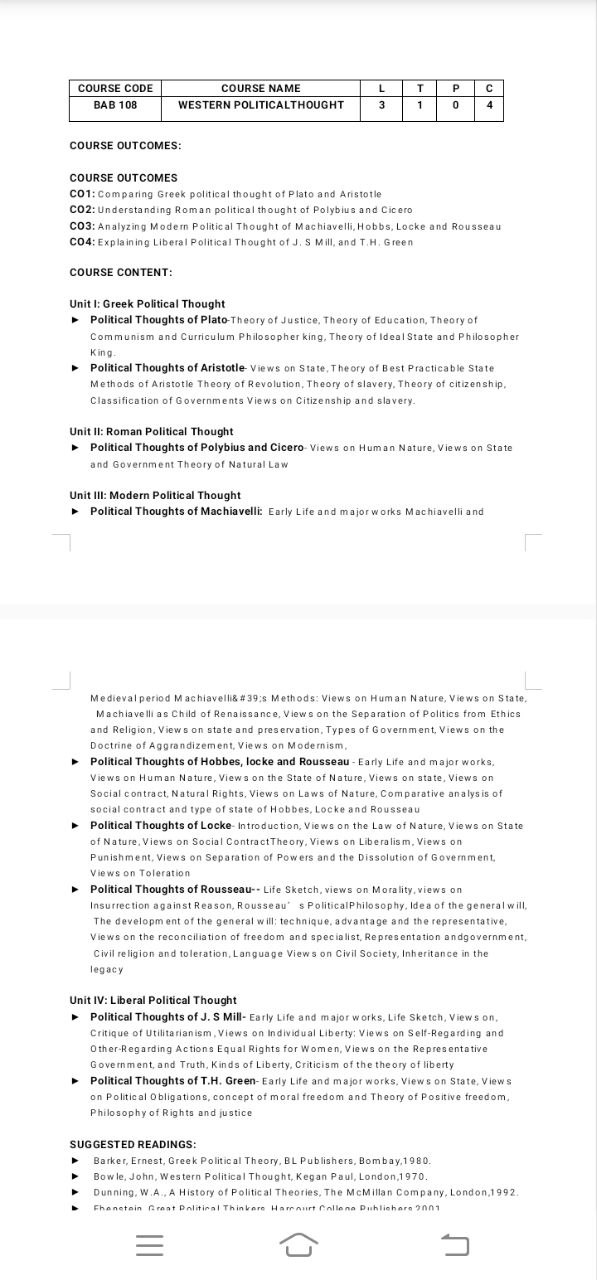
COURSE CODE | COURSE NAME | L | T | P | C
BAB 108 | WESTERN POLITICAL THOUGHT | 3 | 1 | 0 | 4
- CO1: Comparing Greek political thought of Plato and Aristotle
- CO2: Understanding Roman political thought of Polybius and Cicero
- CO3: Analyzing Modern Political Thought of Machiavelli, Hobbes, Locke and Rousseau
- CO4: Explaining Liberal Political Thought of J. S. Mill, and T. H. Green
Unit I: Greek Political Thought
- Political Thoughts of Plato – Theory of Justice, Theory of Education, Theory of Communism and Curriculum, Philosopher King, Theory of Ideal State and Philosopher King.
- Political Thoughts of Aristotle – Views on State, Theory of Best Practicable State, Methods of Aristotle, Theory of Revolution, Theory of Slavery, Theory of Citizenship, Classification of Governments, Views on Citizenship and Slavery.
Unit II: Roman Political Thought
- Political Thoughts of Polybius and Cicero – Views on Human Nature, Views on State and Government, Theory of Natural Law.
Unit III: Modern Political Thought
- Political Thoughts of Machiavelli – Early Life and major works, Machiavelli and Medieval period, Machiavelli’s Methods: Views on Human Nature, Views on State, Machiavelli as Child of Renaissance, Views on the Separation of Politics from Ethics and Religion, Views on State and Preservation, Types of Government, Views on the Doctrine of Aggrandizement, Views on Modernism.
- Political Thoughts of Hobbes, Locke and Rousseau – Early Life and major works, Views on Human Nature, Views on the State of Nature, Views on State, Views on Social Contract, Natural Rights, Views on Laws of Nature, Comparative analysis of Social Contract and type of State of Hobbes, Locke and Rousseau.
- Political Thoughts of Locke – Introduction, Views on the Law of Nature, Views on State of Nature, Views on Social Contract Theory, Views on Liberalism, Views on Punishment, Views on Separation of Powers and the Dissolution of Government, Views on Toleration.
- Political Thoughts of Rousseau – Life Sketch, Views on Morality, Views on Insurrection against Reason, Rousseau’s Political Philosophy, Idea of the General Will, The development of the General Will: technique, agent and the representative, Views on the Reconciliation of Freedom and Specialist, Representation and Government, Civil Religion and Toleration, Language, Views on Civil Society, Inheritance in the Legacy.
Unit IV: Liberal Political Thought
- Political Thoughts of J. S. Mill – Early Life and major works, Life Sketch, Views on Critique of Utilitarianism, Views on Individual Liberty: Views on Self-Regard and Other-Regard Actions, Equal Rights of Women, Views on the Representative Government and Truth, Kinds of Liberty, Criticism of other theories of liberty.
- Political Thoughts of T. H. Green – Early Life and major works, Views on State, Views on Political Obligations, Concept of Moral Freedom and Theory of Positive Freedom, Philosophy of Rights and Justice.
- Teacher: Nidhi Singh
COURSE NAME | L | T | P | C | |
BAB 126 | FUNDAMENTALS OF HUMAN GEOGRAPHY | 3 | 0 | 0 | 3 |
COURSE OUTCOMES: -
CO1: Understanding population dynamics and migration.
CO2: Describing urban structure and development.
CO3: Analysing political systems, states, territory, and borders.
CO4: Evaluating the types and levels of economic activities.
COURSE CONTENT:
Unit I
Ø Basic concepts: Nature and scope of human geography. Branches of human geography concepts of man environment relationship –determinism, Posibilism and probabilism; dichotomy in Physical and Human Geography; primitives life style of mankind and subsequent migration. Division of mankind spatial distribution, physical and social profile of racial groups, ethnic groups, tribal groups and religious groups in the world and in India; early economic activities of mankind: food gathering, hunting, fishing and agriculture, shifting cultivation
Unit II
Ø Human race: Evolution of man; Classification of races; Characteristics of races and their broad distribution; Human adaptation to the environment (i) cold region-Eskimo (ii) hot region Bushman, Bcduin; (iii) plateau –gonds, Masai (iv) Mountain Gujjars, nomads (v) regions of recurrent floods, droughts and other natural hazards; Adaptation in modern society – agricultural, urban and metropolitan;
Unit III
Ø Population Characteristics: Distribution of population, world distribution pattern-physical, economic and social factors influencing, spatial distribution, concepts of over population, under population and optimum population. Zero population growth; Migration internal and international Population conflicts and conflict resolution in developing world, Population theories ; Classical and Modern.
Unit IV
Ø Human settlements: Rural settlement: characteristics, types and regional pattern; Urban settlements: evolution and classification; Rural houses in India: types, classification and regional pattern.
SUGGESTED READINGS
Ø Chisholm, M. (1985): Human Geography, 2nd edition, Penguin Books, London.
Ø de Blij, H.J.(1996): Human Geography: Culture, Society and Space,. 2nd edition. John Wiley and Sons, New York,
Ø Fellman, J. D., Arthur, G., Judith, G., Hopkins, J. and Dan, S. (2007): Human Geography: Landscapes of Human Activities. McGraw-Hill, New York. 10th edition.
Ø Haggett, P. (2004): Geography: A Modern Synthesis. 8th edition, Harper and Row, New York.
Ø Hussain, M. (1994): Human Geography, Rawat Publications, Jaipur.
Ø Johnston, R. J., Gregory, D., Pratt, G. and Watts, M. (2009): The Dictionary of Human Geography. 5th edition, Basil Blackwell Publishers, Oxford.
Ø Kaushik, S.D. and Sharma, A.K. (1996): Principles of Human Geography (in Hindi), Rastogi Publication, Meerut.
Ø Norton, W. (2008): Human Geography, Oxford University Press, New York. 5thed.
Ø Singh, K. N. and Singh, J. (2001): Manav Bhugol. GyanodayaPrakashan, Gorakhpur. 2nd edition.
Ø Singh, L.R. (2005): Fundamentals of Human Geography, Sharda Pustak Bhawan, Allahabad
PRACTICAL
CO1. Understanding the concept and uses of map projection
CO2. Understanding aerial photographs and satellite imageries; elements of aerial photograph and images.
CO3. Describing and Recognizing weather symbols.
CO4. Analysing different types of map projection.
PRACTICAL
Ø Map Projection (Graphical Method): Classification and choice of map projections; Construction, characteristics and use of cylindrical (equal area), conical (One and two standard parallels, Bonne’s) and zenithal: Perspective (gnomonic, stereographic and orthographic) and non-perspective (equal area and equidistant) projections.
Ø Weather Map: Weather symbols, representation of atmospheric features, interpretation of Indian daily weather maps (July and January).
Ø Remote Sensing
Ø Element of Remote Sensing: Fundamentals of remote sensing; Interpretation of aerial photographs and satellite imageries; Elements of aerial photograph and image interpretation.
Ø Interpretation of Aerial photograph and Imagery: Stereoscopic vision test; Determination of photo scale, identification and interpretation of geomorphic features and land use/land cover map from stereogram and satellite images.
- Teacher: Priyanka Gautam
|
COURSE CODE |
COURSE NAME |
L |
T |
P |
C |
|
BAB 110 |
MACRO ECONOMICS |
3 |
1 |
0 |
4 |
COURSE OUTCOMES:
CO1: Understanding the relationship between investment and savings.
CO2: Describing circular flow of income.
CO3: Analyzing the various income identities with government and international trade.
CO4: Evaluating the, relationship between APC and MPC, consumption and income, and effect of multiplier.
COURSE CONTENT:
Unit: I Introduction to Macro economics and National Income Accounting
- Basic issues studied in macro economics;
- measurement of gross domestic product; income, expenditure and the circular flow; real versus nominal GDP;
- price indices; national income accounting for an open economy;
- balance of payments: current and capital accounts.
Unit: II Functions of money;
- Quantity theory of money; determination of money supply and demand;
- credit creation;
- tools of monetary policy.
- Inflation and its social costs; hyperinflation.
Unit: III Classical and Keynesian systems;
- Simple Keynesian model of income determination; IS-LM model; fiscal and monetary multipliers.
- Aggregate Demand and Aggregate Supply Curves
- Derivation of aggregate demand and aggregate supply curves; interaction of aggregate demand and supply.
Unit IV Phillips curve; adaptive and rational expectations; policy in effectiveness debate.
- Short-run open economy models; Mundell-Fleming model; exchange rate determination; purchasing power parity; asset market approach; Dornbusch's overshooting model; monetary approach to balance of payments; international financial markets.
SUGGESTED READINGS:
- Dornbusch, FischerandStartz, Macroeconomics, McGrawHill, 11th edition, 2010.
- N. GregoryMankiw.Macroeconomics, WorthPublishers, 7th edition, 2010.
- OlivierBlanchard, Macroeconomics, PearsonEducation, Inc., 5thedition, 2009.
- Steven M. Sheffrin, Rational Expectations, Cambridge University Press, 2ndedition, 1996.
- AndrewB.AbelandBenS. Bernanke, Macroeconomics, PearsonEducation, Inc., 7thedition, 2011.
- ErrolD ‘Souza, Macroeconomics, Pearson Education,2009
- Paul R. Krugman, Maurice Obstfeld and Marc Melitz, International Economics, Pearson Education Asia, 9thedition, 2012
- Dornbusch, FischerandStartz, Macro economics, McGrawHill, 11thedition, 2010.
- N. Gregory Mankiw.Macro economics, Worth Publishers,7thedition,2010
C01. Understanding the cardinal tenets, perceptions and the intense intellectual demands of the
metaphysical school.
CO2. Describing the concept of Humanism, the way the poets, dramatists and novelists of this
period shaped their concept of Humanism.
CO3.
Analyzing the renaissance thoughts of the major writers who shaped the renaissance ideology and their influence on the times that followed
CO4. Evaluating the themes and techniques of the Renaissance theatre such as Shakespeare,
Christopher Marlowe and Ben Jonson.
Unit I: Drama:
• Shakespeare: Hamlet
Shakespeare: Midsummer Night's Dream
Unit II: Drama:
- Christopher Marlowe: Doctor Faustus
- John Webster: Duchess of Malfi
Unit III: Prose:
• Aristotle: Poetics
Longinus: On the Sublime Bacon: Of Studies; Of Truth Book of Job:
Oldiestament
Unit IV: Poetry:
- Chaucer: "The GeneralPrelegue
- Spenser: Epithalamion Sonnets 30 ("My love is like to ice, and I to fire") & 75
("One day I wrote her name upon thestrand") - Donne: Batter My Heart; Death be not Proud; The Flea
- Marvell: To his coy mistress
- Teacher: Riya Vardhan Saxena
COURSE OUTCOMES
CO 1: Understanding the concept, characteristics, and different types of disabilities.
CO 2: Describing the concept of exceptionality and inclusive education.
CO 3: Applying the legal and policy perspectives of inclusive education.
CO 4: Analysing innovative practices in the education of children with diversities.
Programme Educational Outcomes
Students will be able to-
PSO 1: integrate theoretical and practical knowledge of their respective subject in classroom practice.
PSO-2: apply their knowledge of core content and pedagogy to set goals and objectives for learning based on Curriculum, and design instruction that engages students in meaningful learning activities.
PSO-3: appreciate the diversity of learners and create appropriate learning environment to assure a focus on learning of all students.
PSO-4: deliver meaningful learning experiences for all students by integrating their knowledge and applying a variety of communication, instructional, and assessment strategies in their teaching.
PSO-5: demonstrate their commitment for continuous self-improvement by engaging in professional development activities and collaborative and reflective practices to improve teaching and learning that contribute to the revitalization of the teaching profession.
PSO-6: use effective and appropriate verbal, nonverbal, written, and media communication techniques in their teaching, professional collaboration, and interactions with students, colleagues, parents, and the community.
PSO-7: demonstrate professional ethics and responsibilities as an educational practitioner.
PSO-8: recognize the need for and have the preparation and ability to engage in independent and life-long learning in the broadest context of knowledge explosion and technological change.
COURSE CONTENT
UNIT I: Concept of Special Needs and Learning Disabilities
- Understanding diversities and differences concept, disability as a social construct, difference between disability and impairment
- Characteristics, causes, and types of various disabilities:
- Sensory impairment (hearing impairment, visual impairment, speech impairment), cognitive disabilities (autism spectrum disorder and intellectual disabilities), physical disabilities (cerebral palsy and locomotor)
- Meaning, kinds of various learning disabilities (dyslexia, dysgraphia, dyscalculia, dyspraxia). signs, symptoms, and intervention strategies for learning disabilities
UNIT II: Inclusive Education and Inclusion regarding Children with Special Needs
- Philosophy of inclusion with special reference to children with disabilities, transition from segregation to inclusion,
- Concept, meaning, and need of inclusive education, principles of inclusive education, models of inclusion
- Concept of an inclusive school, infrastructure, and accessibility, awareness and positive attitude towards disability, the process of inclusion, concerns and issues across disabilities
- Modification of curriculum including assessment, universal design for teaching-learning process. barriers to inclusive education
UNIT III: Legal and Policy Perspectives of Inclusive Education
- International declarations and conventions: Salamanca statement and Framework of Action 1994. Educational provisions in the UN convention on the rights of persons with disabilities (UNCRPD) 2006
- Constitutional Provisions. Education of students with disabilities in NPE 1968, 1986. POA(1992), PWD Act (1995). RCI Act (1992). RTE Act (2009), Education in the National Policy on Disability, 2006, RPWD Act 2016, ΝΕΡ 2020
- Role of organizations for the education of children with disabilities. Rehabilitation Council of India (RCI), National Institute of Different Disabilities. Composite Regional Centres (CRCs). District Disability Rehabilitation Centres (DDRCs), Non-Voluntary Govt. Organizations (NGOs)
UNIT IV: Inclusive Practices: Role of Teacher and Support System
- Schools awareness and readiness for addressing learning difficulties, role of teachers (both regular and special), assistive and adaptive technologies in inclusive setup, use of ICT. equipment, and other technologies for different disabilities
- Pedagogical Strategies to respond to individual needs of learners in classroom Peer tutoring. cooperative learning strategy, social learning, buddy system, reflective teaching, multisensory teaching
- Support Services and Partnership in Teaching: Supportive services required for meeting special needs in school, developing a positive relationship between school and home, the collaboration between teacher and special educator, parents, outsourced experts, and students.
The students will be required to:
- Visit an inclusive or special school to observe and understand the transactional processes, school ethos, and student-teacher relationships. They have to submit and present a report based on their observations.
- Prepare individualized learning materials to meet the needs of a child with any of the disabilities along with a manual describing how to use them, effectively
- Carry out a case study of a child having a particular disability, and discuss aim the class
- Take any topic of their interest from the school curriculum, and chalk out the process of teaching it along with teaching aids in an inclusive classroom.
BOOKS RECOMMENDED:
- Adrian, A. & John, E. (1998). Educating children with special needs. New Delhi: Prentice&Hall.
- Alur. M., & Buch. M. (2010). The Journey for inclusive Education in the Indian subcontinent. New York: Routledge.
- Jha. M. M. (2002). School without walls: Inclusive education for all. Oxford: Heinemann
- Mangal. S.K. (Ed). (2011). Educating exceptional children. New Delhi. PHI Learning Private Limited.
- Suzanne, E. W. (2000). Inclusive education: A casebook and reading for prospective and practice teachers. New York: Routledge.
- Teacher: Dr. Saraswati Ghosh
|
Course Code |
Course Name |
L |
T |
P |
C |
|
IKS102 |
Understanding India-II (Indian Ethos and Knowledge Systems) |
2 |
0 |
0 |
2 |
COURSE OUTCOMES:
CO1: Recognizing the vast corpus of knowledge traditions of India.
CO2: Developing an appreciation for Indian ethos and knowledge system.
CO3: Applying their acquired research and critical thinking skills in multidisciplinary themes.
CO4: Summarizing and passing on their learning to their students of different Indian traditions in an easily digestible manner.
COURSE CONTENT
UNIT - I : Introduction of Knowledge of India
c) Philosophy, Ethics & Values: Schools of Philosophy Vaishesika, Nyaya, Samkhya, Yoga, Purva Mimansa and Vedanta or Uttara Mimansa (theory and the major thinkers) – and Jain, Buddhist, and Charvak traditions.
d) Vedanta: philosophical systems (Advaita, Vishishtadvaita, Dvaita).
e) Ethics, morality, and social dilemma (including self-leadership) and their relevance in today‘s time.
f) How do Indians value spirituality? Spirituality and Social Responsibility; Importance of Spirituality in current times.
g) Using ethics in a technologically volatile world: leading an ethical and modern life.
h) Practical Vedanta for well-being (mindfulness, inter-connectedness, society-self relationship, etc.).
UNIT – II Culture- Lifestyle:
a) Food (regional cuisines, ayurvedic diet, food and festival, vegetarianism, Jainism in food, food and hospitality, and globalization).
b) Clothes (traditional Indian clothing, textile arts, religious costumes, clothing status, clothing, gender, globalization in clothing).
c) Sports (traditional Indian sports, martial arts, sports, and gender, sports & globalization).
d) The lifestyle of Yoga; adapting ancient lifestyle – A path towards longevity.
UNIT - III : Science & Technology
a) Arithmetic and logic.
b) Natural sciences: math, physics, metallurgy, and chemistry.
c) Astronomy: India‘s contributions to the world.
d) Indian notions of time and space.
e) Technology in the economy: agriculture, transportation, etc.
UNIT - IV Linguistic Traditions
a) History of linguistics in India (conceptualizing ancient Indian linguistics, oral traditions, etc.).
b) Language as Culture: Evolution of Languages over the years & language as building blocks to different cultures and society
c) Language: Identity, culture, and History.
SUGGESTIVE PRACTICUM
Practicum will include organization of day trips that help student teachers watch events relating to visual and performing art; activities that enable student teachers to identify and record through photos, videos, etc. the elements of ancient architecture still existing in the city around them; organization of Individual and group presentations based on themes such as Polity, Law and Economy etc., organization of a ‗Knowledge of India‘ day in the institution to celebrate the culture (food, clothes, etc.) that they would have been explored in lectures and tutorials; interactions with family members, elders, neighbors, and other members of society about the evolution of local systems and economy etc.
Suggestive Reading Materials
· Aurobindo, Sri, 1997, India's Rebirth, Paris: Institut de Recherches Evolutives and Mysore: Mira Aditi, 1 ed., 1993.
· The Bhagvad-GfM (BG).
· Bhartrhari, VakyapadTya
· Kapoor, Kapil, 1994, "Texts of the Oral Tradition," Language, Linguistics and Literature : The Indian Perspective, Delhi, Academic Foundation.
· Balasubramanian, A.V. and M. Radhika, 1989, Local Health Traditions : An Introduction, Chennai: Lok Swasthya Parampara Samvardhan Samithi.
· Caraka SarhhitS, Sulra Slhana, Chapter I, s'loka 12
- Teacher: DEVANSHU SINGH
Unit I: Medieval India: Delhi. Sultanate:
Literary Sources-Foundation of Delhi. Sultanate-Qutb-ud-din Aibak-Iltutmish-Razia Sultana – Ghiasuddin Balban-The Khiljis-Allauddin Khilji-The Tughlaqs-Mohammed bin Tughlaq- theories of Kingship
Unit II: Mughal Empire and the Marathas
Advent of Babar and the foundation of the Mughal Empire-Shershah Sur-Career and Achievements-Akbar-Conquests-Administration-Religious policy- Aurangzeb-Religious Policy-Deccan policy- Shivaji-Conquests-Administration Third battle of Panipat.
Unit III: Society and Economy under the Mughals
The Mughal Society and Economy-Contributions to art and architecture, The Shahis and the Marathas - Decline of the Mughal Power,
Unit IV: New Religions and Social Reformers of Medieval India
Rise of Monotheistic religions in India-Kabir-Nanak-Sufism-Sheik Nizamuddin Auliya-Sheik Moinuddin Chisti-The saints of Maharashtra-Namdev, Eknath and Tukaram-Rise of Veera Saivism and Vaishnavism in South
- Teacher: Pushpendra Kumar