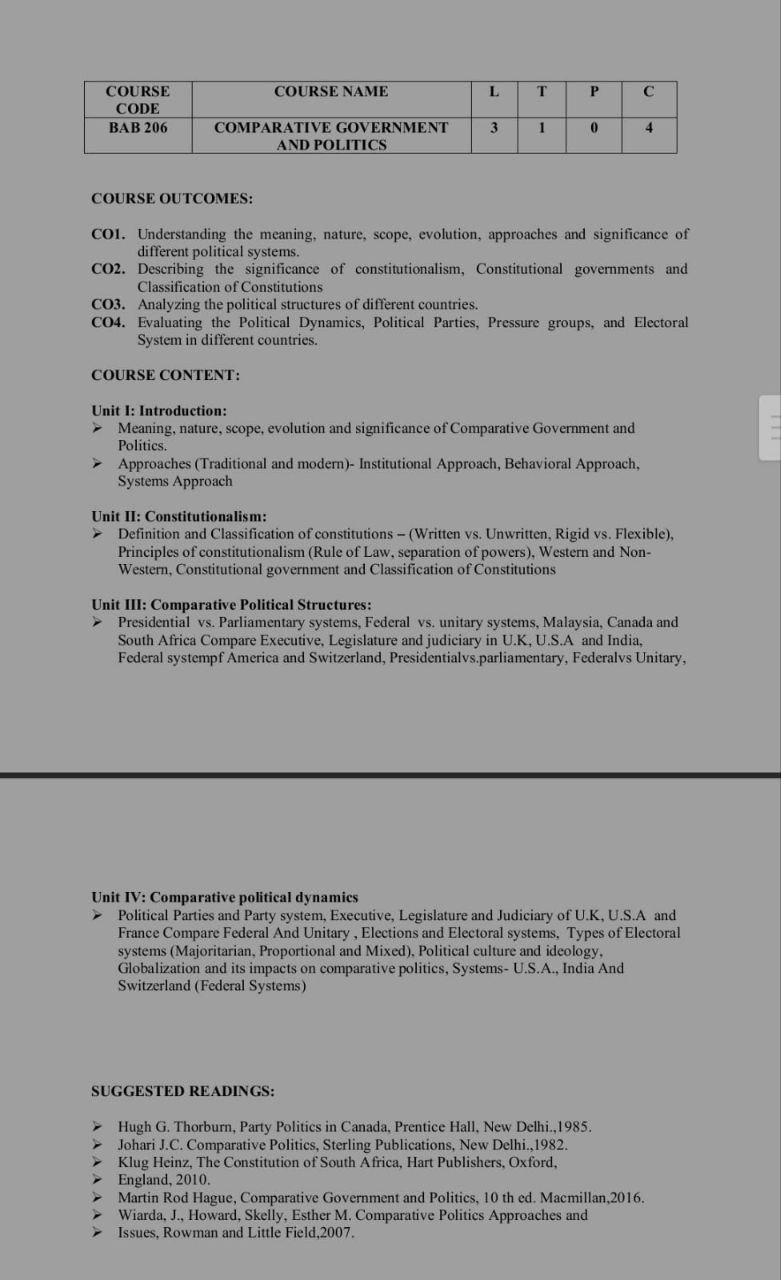
COURSE CODE | COURSE NAME | L | T | P | C
BAB 206 | COMPARATIVE GOVERNMENT AND POLITICS | 3 | 1 | 0 | 4
COURSE OUTCOMES:
CO1. Understanding the meaning, nature, scope, evolution, approaches and significance of different political systems.
CO2. Describing the significance of constitutionalism, Constitutional governments and Classification of Constitutions.
CO3. Analyzing the political structures of different countries.
CO4. Evaluating the Political Dynamics, Political Parties, Pressure groups, and Electoral System in different countries.
COURSE CONTENT:
Unit I: Introduction:
➤ Meaning, nature, scope, evolution and significance of Comparative Government and Politics.
➤ Approaches (Traditional and modern)- Institutional Approach, Behavioral Approach, Systems Approach
Unit II: Constitutionalism:
➤ Definition and Classification of constitutions – (Written vs. Unwritten, Rigid vs. Flexible), Principles of constitutionalism (Rule of Law, separation of powers), Western and Non-Western, Constitutional government and Classification of Constitutions
III: Comparative Political Structures:
➤ Presidential vs. Parliamentary systems, Federal vs. unitary systems, Malaysia, Canada and South Africa
➤ Compare Executive, Legislature and judiciary in U.K, U.S.A and India
➤ Federal system of America and Switzerland, Presidential vs. parliamentary, Federal vs. Unitary
Unit IV: Comparative political dynamics
➤ Political Parties and Party system, Executive, Legislature and Judiciary of U.K, U.S.A and France
➤ Compare Federal And Unitary
➤ Elections and Electoral systems, Types of Electoral systems (Majoritarian, Proportional and Mixed)
➤ Political culture and ideology, Globalization and its impacts on comparative politics
➤ Systems- U.S.A., India And Switzerland (Federal Systems)
SUGGESTED READINGS:
➤ Hugh G. Thorburn, Party Politics in Canada, Prentice Hall, New Delhi.,1985.
➤ Johari J.C. Comparative Politics, Sterling Publications, New Delhi.,1982.
➤ Klug Heinz, The Constitution of South Africa, Hart Publishers, Oxford, England, 2010.
➤ Martin Rod Hague, Comparative Government and Politics, 10th ed. Macmillan, 2016.
➤ Wiarda, J., Howard, Skelly, Esther M. Comparative Politics. Approaches and Issues, Rowman and Little Field, 2007.
- Teacher: Nidhi Singh
COURSE CODE | COURSE NAME | L | T | P | C |
BAB 226 | EVOLUTION OF GEOGRAPHICAL THOUGHT | 3 | 0 | 0 | 3 |
COURSE OUTCOMES:
CO1. Understanding the evolution of the philosophy of Geography
CO2. Describing the evolution of geographical thoughts from ancient to modern times.
CO3. Analyzing the relationship of Geography with other disciplines and man-environment relationships.
CO4. Evaluating modern and contemporary principles of Empiricism, Positivism, Structuralism, Human and Behavioural Approaches in Geography.
COURSE CONTENT
Unit I: Basics of Geographical Thought:
Ø Philosophy of geography; Place of geography in the knowledge system; Fundamental concepts of geography: location, space, place, region, time; Geography as a science; Approaches to the study of geography.
Unit II :Geographical Thought:
Ø Greek, Roman, Arab; Geography re-thought: Varenius and Immanuel Kant; Modern period of classical geography: Humboldt and Ritter.
Unit III Schools of Geographical Thought:
Ø German, French, British and American; Quantitative revolution and its challenges; Dualism and Dichotomy in geography.
Unit IV Evolution of Geography as a Discipline in India:
Ø Geography in ancient and medieval India; Development of geography in colonial period, post- independence scenario; Indian geography: contemporary trends.
SUGGESTED READINGS
Ø Ali, S.M. (1960): Arab Geography, Institute of Islamic Studies, Aligarh Muslim University, Aligarh, First Edition.
Ø Diddee, J. (ed.) (1990): Indian Geography, Institute of Indian Geographers, Pune, first edition.
Ø Dikshit, R. D. (2003): Geographical Thought. A Critical History of Ideas. Prentice-Hall of India, New Delhi. (in English and Hindi).
Ø Dube, B. (1967): Geographical Concepts in Ancient India, National Geographical Society of India, Varanasi
Ø Getice, A., Getis, J. and Fellman, J. D. (2007): Introduction to Geography. 10th edition. McGraw Hill, New York.
Ø Hartshorne, R. (1959): Perspective on the Nature of Geography, John Murray, London
Ø Harvey, D. (1969): Explanations in Geography. Arnold, London.
Ø Holt-Jensen, A. (1980): Geography: Its History and Concepts. Harper and Row Publishers, London.
Ø Husain, Majid. (2002): Evolution of Geographical Thought, Rawat Publications, Jaipur.
Ø Johnston, R. and Sidaway, J.D. (2004): Geography and Geographers: Anglo-American Human Geography Since 1945, Arnold Publishers, London.
Ø Johnston, R., Gregory, D., Pratt, G., Watts, M. and Whatmore, S. (2003): The Dictionary of Human Geography. Blackwell Publishers, Oxford. 5th edition.
PRACTICAL
Unit -1
Ø Principles of Field Training: Meaning and objectives of field training; Field as laboratory of geography; Contents of field training: physical, social, economic and cultural; Field training techniques; Field training-based report writing.
Unit -2
Field Visit: Students will visit any one of the following geographical regions for field training for duration of one to two weeks: Himalayan Region, Vindhyan Plateau, Thar Desert and Aravali Hills, Coastal region of India, North-eastern India and Nepal.- Teacher: Priyanka Gautam
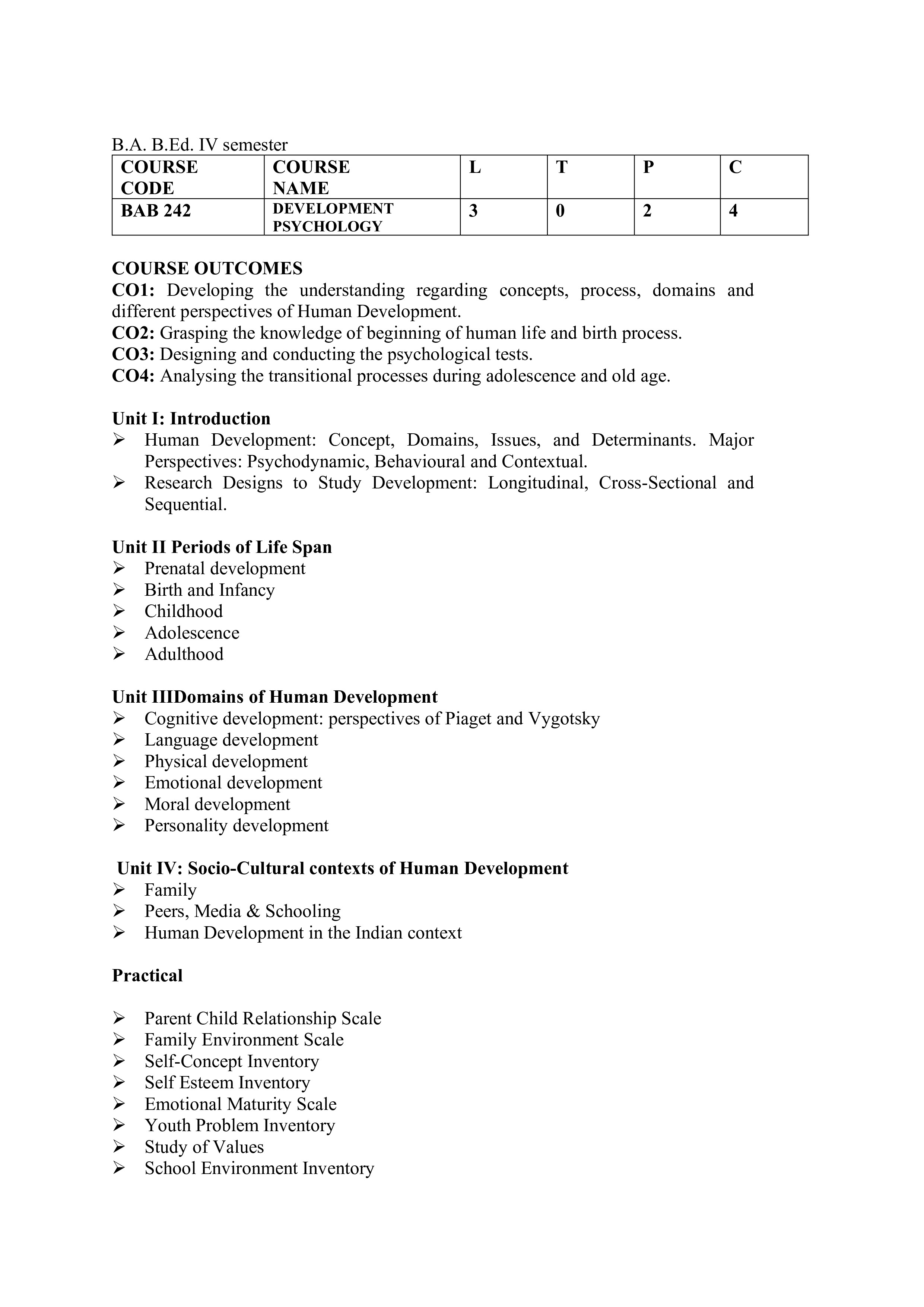
|
COURSE CODE |
COURSE NAME |
L |
T |
P |
C |
|
BAB 242 |
DEVELOPMENT PSYCHOLOGY |
3 |
0 |
2 |
4 |
COURSE OUTCOMES
CO1: Developing the understanding regarding concepts, process, domains and different perspectives of Human Development.
CO2: Grasping the knowledge of beginning of human life and birth process.
CO3: Designing and conducting the psychological tests.
CO4: Analysing the transitional processes during adolescence and old age.
Unit I: Introduction
Ø Human Development: Concept, Domains, Issues, and Determinants. Major Perspectives: Psychodynamic, Behavioural and Contextual.
Ø Research Designs to Study Development: Longitudinal, Cross-Sectional and Sequential.
Unit II Periods of Life Span
Ø Adolescence
Unit IIIDomains of Human Development
Ø Cognitive development: perspectives of Piaget and Vygotsky
Ø Language development
Ø Physical development
Ø Emotional development
Ø Moral development
Ø Personality development
Unit IV: Socio-Cultural contexts of Human Development
Ø Family
Ø Peers, Media & Schooling
Ø Human Development in the Indian context
Practical
Ø Parent Child Relationship Scale
Ø Family Environment Scale
Ø Self-Concept Inventory
Ø Self Esteem Inventory
Ø Emotional Maturity Scale
Ø Youth Problem Inventory
Ø Study of Values
Ø School Environment Inventory
Ø Impulsiveness scale
Ø Case study
Note: Students are to Conduct and report at least 2 practical. The examiner will allot one practical at the time of examination
SUGGESTED READINGS
Ø Berk, L. E. (2010).Child Development (9th Ed.). New Delhi: Prentice Hall.
Ø Mitchell, P. and Ziegler, F. (2007). Fundamentals of development: The Psychology of Childhood. New York: Psychology Press.
Ø Papalia, D. E., Olds, S.W. & Feldman, R.D. (2006). Human development (9th Ed.). New Delhi: McGraw Hill.
Ø Santrock, J. W. (2011). Child Development (13th Ed.). New Delhi: McGraw Hill.
Ø Santrock, J.W. (2012).Life Span Development (13th ed) New Delhi: McGraw Hill.
Ø Saraswathi, T.S. (2003). Cross-cultural perspectives in Human Development: Theory, Research and Applications. New Delhi: Sage Publications.
- Teacher: Dr. YOGITA SHARMA
|
BAB 232 |
Differential Equations & Mechanics |
L |
T |
P |
C |
|
5 |
0 |
0 |
5 |
COURSE OUTCOMES
CO1. Describing various methods of solving differential equations, partial differential equations of first order and second order and to have qualitative applications.
CO2. Analyzing differential equations.
CO3. Understanding basic mechanics such as simple harmonic motion, motion under other laws and forces.
CO4. Evaluating mechanic such as hydrodynamics, this will be helpful in getting employment in industry.
Course Content
(Differential Equations)
UNIT I
- Second order linear differential equations with variable coefficients:
- Use of a known solution to find another, normal form, method of undetermined coefficient, variation of parameters,
- Series solutions of differential equations,
- Power series method.
UNIT II
- Bessel, Legendre and Hypergeometric functions and their properties,
- recurrence and generating relations.
UNIT III
- Origin of first order partial differential equations.
- Partial differential equations of the first order and degree one,
- Lagrange's solution,
- Partial differential equation of first order and degree greater than one.
- Charpit's method of solution,
- Surfaces Orthogonal to the given system of surfaces.
UNIT IV
- Origin of second order PDE, Solution of partial differential equations of the second and higher order with constant coefficients,
- Classification of linear partial differential equations of second order, Solution of second order partial differential equations with variable coefficients,
- Monge's method of solution.
Part B
(Mechanics)
UNIT V
- Frame of reference, work energy principle,
- Forces in three dimensions,
- Poinsot's central axis, Wrenches,
- Null lines and planes.
UNIT VI
- Virtual work, Stable and Unstable equilibrium,
- Catenary, Catenary of uniform strength.
UNIT VII
- Velocities and accelerations along radial and transverse directions, and along tangential and normal directions,
- Simple Harmonic motion, Motion under other law of forces.
- Elastic strings, Motion in resisting medium, Constrained motion, Motion on smooth and rough plane curves.
UNIT VIII
- Motion of particles of varying mass, Rocket motion,
- Central orbit, Kepler's laws of motion, Motion of particle in three dimensions,
- Rotating frame of reference, Rotating Earth,
- Acceleration in terms of different coordinates systems.
Suggested Readings
(Part-A Differential Equations):
- G.F. Simmons, Differential Equations with Application and Historical Notes, Tata–McGraw Hill
- B. Rai, D.P. Choudhary& H. J. Freedman, A Course of Ordinary Differential Equations, Narosa
- Ian N. Snedden, Elements of Partial Differential Equations, Dover Publication
- L.E. Elsgolts, Differential Equation and Calculus of variations, University Press of the Pacific.
- Suggested digital plate form: NPTEL/SWAYAM/MOOCs
- Course Books published in Hindi may be prescribed by the Universities.
(Part-B Mechanics):
- R.C. Hibbeler, Engineering Mechanics-Statics, Prentics Hall Publishers
- R.C. Hibbeler, Engineering Mechanics-Dynamics, Prentics Hall Publishers
- A. Nelson, Engineering Mechanics Statics and Dynamics, Tata McGraw Hill
- J.L. Synge & B.A. Griffith, Principles of Mechanics, Tata McGraw Hill
- Suggested digital plate form : NPTEL/SWAYAM/MOOCs
- Teacher: Narendra Kumar
UNIT I:
Making of the Constitution:
Basic Features - Institutions – Composition of Constituent Assembly, Working of the Constitution Assembly, Functions of Constituent Assembly, Major Committees of C.A.
UNIT II:
The Initial Years:
Consolidation – Challenges after independent India- Integration of Princely States, Linguistic Reorganization - Justice S K Dhar Commission, JVP Committee, Fazal Ali Commission, Building a secular nation- Social, Political and Economic Equality.
UNIT III:
Consolidating the Nation:
India Democratic and
Republic Nation - First Election, Political Parties - Foreign Policy - Foreign Policy under Nehru, Nehru’s Panchsheel, Non-Aligned India,
Economy.
UNIT IV:
Test of Democracy:
Land reforms – Kumarappa committee, Abolition of Zamindars, Tenancy reforms, Bhoodaan Movement, Workers Movements Tribal Unrest, Dalit movements, Women’s movements, Emergency Years.
- Teacher: Pushpendra Kumar
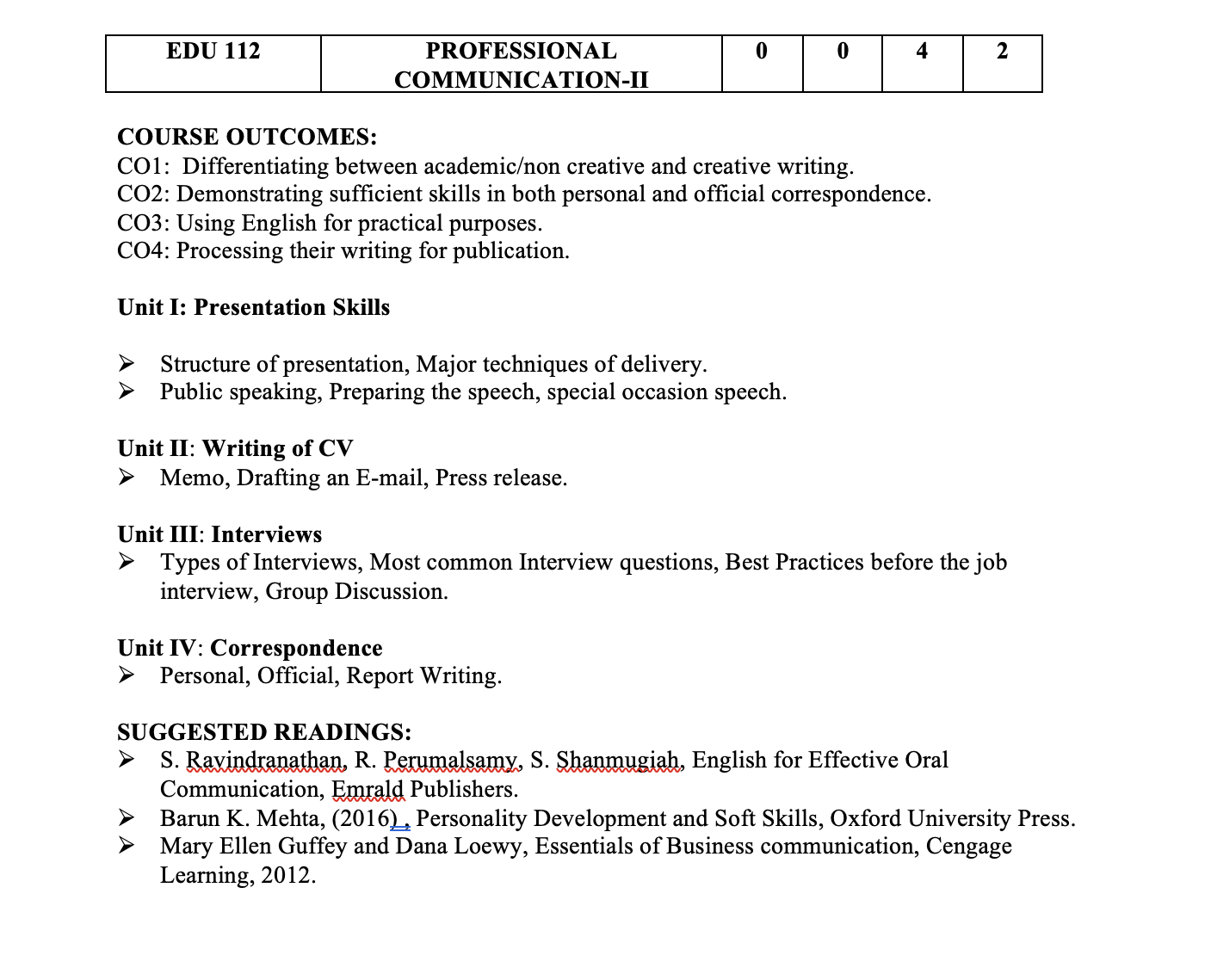
COURSE OUTCOMES:
CO1: Differentiating between academic/non creative and creative writing.
CO2: Demonstrating sufficient skills in both personal and official correspondence.
CО3: Using English for practical purposes.
CO4: Processing their writing for publication.
Unit I: Presentation Skills
Structure of presentation, Major techniques of delivery.
• Public speaking, Preparing the speech, special occasion speech.
Unit II: Writing of CV
> Memo, Drafting an E-mail, Press release.
Unit III: Interviews
> Types of Interviews, Most common Interview questions, Best Practices before the job interview, Group Discussion.
Unit IV: Correspondence
• Personal, Official, Report Writing.
This course is designed to develop students’ practical communication and writing skills in English, focusing on both academic and real-world applications. It helps learners clearly understand the difference between creative writing (which involves imagination and personal expression) and non-creative or academic writing (which is formal, structured, and fact-based). The course aims to make students confident in using English effectively for professional, personal, and public purposes.
In Unit I, the focus is on presentation and public speaking skills. Students learn how to structure a good presentation, organize ideas logically, and deliver them confidently. They are trained in important techniques such as voice modulation, body language, and audience engagement. This unit also includes preparing speeches for different occasions, helping students overcome stage fear and communicate their thoughts clearly in front of an audience.
Unit II deals with practical writing skills required in professional life. Students learn how to prepare a proper CV (Curriculum Vitae) that highlights their qualifications and skills effectively. They are also trained in writing formal documents such as memos, emails, and press releases. This unit emphasizes clarity, correctness, and professionalism in written communication, which is essential in workplaces.
Unit III focuses on interview skills and group discussions, which are crucial for career development. Students learn about different types of interviews, common questions asked by employers, and strategies to answer them confidently. They are also guided on how to prepare before an interview, including research, grooming, and communication techniques. Group discussions help students improve their ability to express ideas, listen to others, and participate effectively in team conversations.
Unit IV covers different types of correspondence, including personal and official writing, as well as report writing. Students learn how to write letters, applications, and reports in a clear and structured manner. This unit helps them develop the ability to communicate formally and informally depending on the situation.
Overall, the course aims to make students proficient in English communication, both spoken and written. It prepares them for real-life situations such as job applications, workplace communication, public speaking, and publishing their writing. By the end of the course, students gain confidence, clarity, and professionalism in using English effectively in various contexts.
- Teacher: Riya Vardhan Saxena
COURSE OUTCOMES:
CO1. Understanding the perspectives and insights into the heterogeneous themes and schools that populated Twentieth Century British Literature - movements like symbolism, imagism, movement poetry, Theatre of the absurd, postmodernism
CO2. Describing the most influential novelists and essayists of Twentieth Century
British Literature.
CО3. Analyzing the contributions made by some of the contemporary writers and developing scholarly insights into the contemporary English literature.
CO4. Applying a deeper perspective into themes that dominated twentieth century
British poetry.
In Unit I, the prescribed poetry reflects the complexities and anxieties of modern life through the works of major twentieth-century poets. W. B. Yeats in The Second Coming presents a world that has lost its moral and social order, especially in the aftermath of World War I, where chaos prevails and the future appears uncertain and terrifying, symbolized by a monstrous beast replacing the expected return of Christ. T. S. Eliot in The Love Song of J. Alfred Prufrock explores the inner conflict of a modern individual who is unable to act due to fear, insecurity, and self-doubt, reflecting the loneliness of urban life. Philip Larkin in The Whitsun Weddings presents a realistic view of life through ordinary wedding scenes, suggesting that human relationships are based more on routine and uncertainty than on ideal romance. Sylvia Plath in Lady Lazarus expresses themes of death and rebirth, where the speaker repeatedly survives suffering and rises again with strength, showing resistance and personal power.
In Unit II, Sons and Lovers by D. H. Lawrence explores deep emotional and psychological conflicts within a family, focusing on Paul Morel’s intense attachment to his mother, which prevents him from forming stable relationships with other women. The novel also reflects the effects of industrial life on human emotions and highlights the struggle between personal freedom and family control.
In Unit III, the dramas present different views of life and faith. Samuel Beckett in Waiting for Godot shows the meaninglessness and uncertainty of human existence through two characters who wait endlessly for someone who never arrives, symbolizing the lack of purpose in life. In contrast, T. S. Eliot in Murder in the Cathedral presents the story of Thomas Becket, who sacrifices his life for his religious beliefs, emphasizing that spiritual values are more important than political power.
In Unit IV, Lord of the Flies by William Golding explores human nature through the story of boys stranded on an island who gradually become violent and savage in the absence of rules and authority. The novel suggests that civilization is fragile and that human beings have an inherent tendency toward evil, which emerges when social order breaks down.
- Teacher: Riya Vardhan Saxena