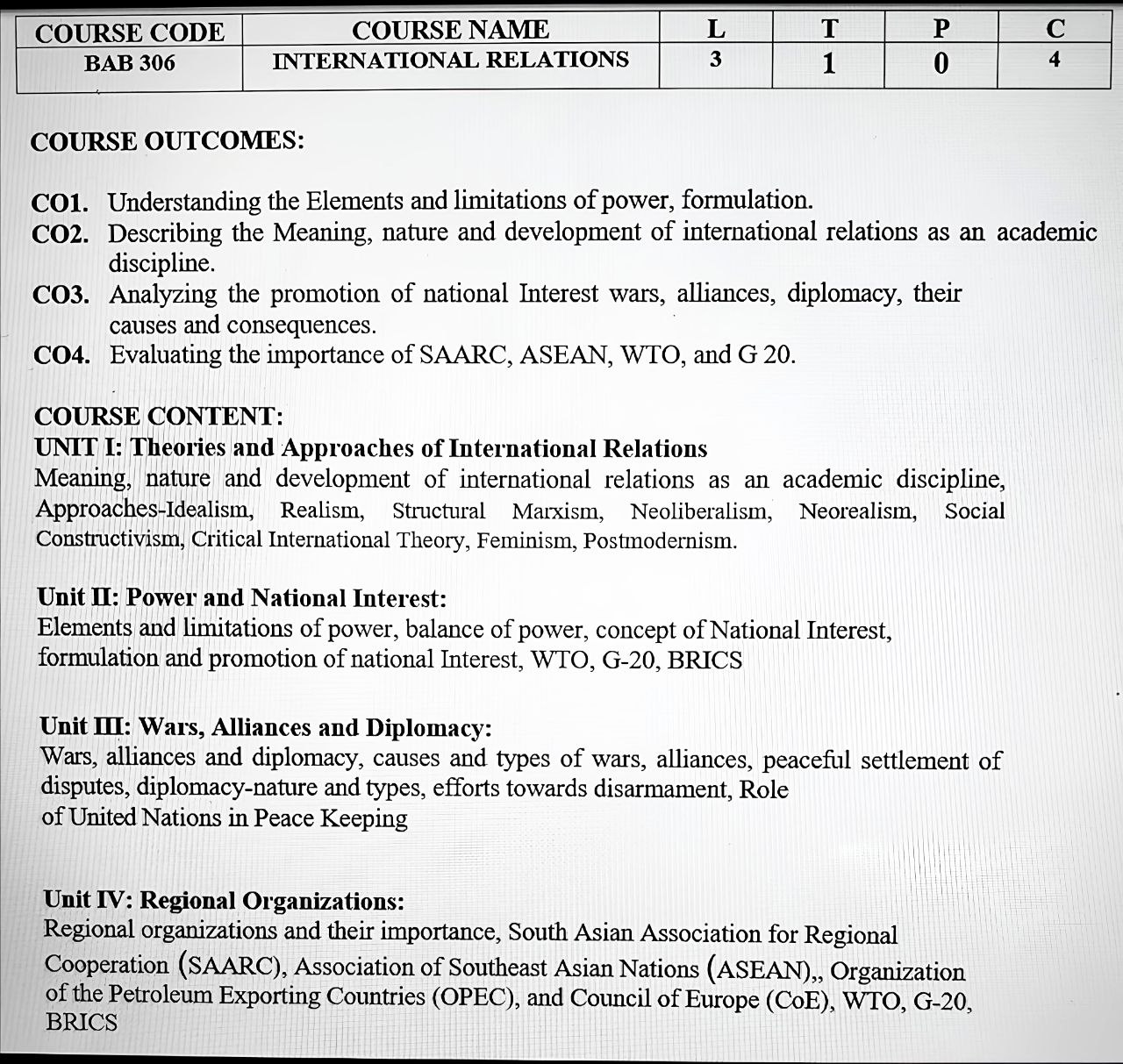
COURSE CODE | COURSE NAME | L | T | P | C
BAB 306 | INTERNATIONAL RELATIONS | 3 | 1 | 0 | 4
COURSE OUTCOMES:
CO1. Understanding the Elements and limitations of power, formulation.
CO2. Describing the Meaning, nature and development of international relations as an academic discipline.
CO3. Analyzing the promotion of national Interest wars, alliances, diplomacy, their causes and consequences.
CO4. Evaluating the importance of SAARC, ASEAN, WTO, and G 20.
COURSE CONTENT:
Unit I: Theories and Approaches of International Relations
Meaning, nature and development of international relations as an academic discipline,
Approaches–Idealism, Realism, Structural Marxism, Neoliberalism, Neorealism, Social Constructivism, Critical International Theory, Feminism, Postmodernism.
Unit II: Power and National Interest:
Elements and limitations of power, balance of power, concept of National Interest, formulation and promotion of national Interest, WTO, G-20, BRICS
Unit III: Wars, Alliances and Diplomacy:
Wars, alliances and diplomacy, causes and types of wars, alliances, peaceful settlement of disputes, diplomacy–nature and types, efforts towards disarmament, Role of United Nations in Peace Keeping
Unit IV: Regional Organizations:
Regional organizations and their importance, South Asian Association for Regional Cooperation (SAARC), Association of Southeast Asian Nations (ASEAN), Organization of the Petroleum Exporting Countries (OPEC), and Council of Europe (CoE), WTO, G-20, BRICS
- Teacher: Nidhi Singh
COURSE CODE | COURSE NAME | L | T | P | C |
SSC101 | PEDAGOGY OF SOCIAL SCIENCES | 3 | 1 | 0 | 4 |
COURSE OUTCOMES:
CO1: Understanding various pedagogical principles involved in teaching of Social Studies
CO2: Describing the principles of curriculum development, its transaction and evaluation
CO3: Creating lesson plan with the help of advanced technology.
CO4: Applying teaching aids effectively in the class-room.
COURSE CONTENT:
UNIT-I
Meaning, Nature and Importance
Ø Meaning, nature and importance of Social Science teaching.
Ø Values of teaching Social Sciences as an integrated subject at school level.
Ø Correlation of Social Sciences with History, Economics, Civics, Geography, Sociology, Mathematics, Natural Science and Psychology
UNIT-II
Aims, objectives and Curriculum
Ø Aims and instructional objectives of the teaching social sciences at different school levels.
Ø Bloom’s taxonomy and writing objectives in behavioral term. Revised Taxonomy
Ø Curriculum and content of social sciences- concept and importance of curriculum, objectives of social science curriculum, principles of selection of content, social science syllabus prescribed by NCERT.
UNIT –III
Approaches and Methods
Ø Story telling Method, text book Method, Lecture cum demonstration, Question answer method, Discussion method, Assignment method, project method, problem solving method, socialized recitation method.
Ø Techniques and devices of teaching - Seminars, group discussion, assignments, excursions, supervised study.
Ø Social science teacher and Professional growth.
Ø Meaning, importance, approaches and preparation of lesson plan and UNIT plan.
Ø Skills of teaching Social Studies: Skill of Explaining. Skill of Illustration with Examples, Skill of Reinforcement, Skill of Probing Questions and Skill of Stimulus Variation
UNIT-IV
Learning resources in social science
Ø Audio-visual aids-teaching aids- Textbook & Reference Books, Documentaries, News Papers, Maps, Community, Atlas, and E-resources (Blog, World Wide Web, and Social Networking.), Need, uses, kinds and advantages.
Ø Co-curricular activities in social science and use of activities and play-way devices in social science.
Ø ICT materials in teaching learning of social science, Use of ICT video clips, Power-point presentation etc.
Ø Text book – Meaning, importance and criteria of a good text book and evaluation of a social science text book.
Ø Social science laboratory and Museum, Library, Social science club, Wall- Magazines, Field trip or educational tours.
UNIT-V
Evaluation in social science
Ø Meaning and importance of evaluation.
Ø Formative and summative evaluation.
Ø Types of Evaluation oral test, written test- Essay Type Test, (ii) Objectives Type Test.
Ø Construction of test items-UNIT test and Examination question paper at secondary level.
Ø New approaches to Assessment – Question bank, Open Book Examination, Grading & Credit System.
Practical Assignment/Field engagement (Any one):
Ø Fields trip to History Museums, Historical monuments
Ø Dramatization of any Historical event.
Ø Analysis of life and character of a (any two of the following) Historical Figures: Shaheed Bhagat Singh, Rani Laxmi Bai, Sardar Vallabhbhai Patel, Sarojini Naidu, Jawaharlal Nehru, Subhash Chandra Bose.
Ø Identifying and Evaluating ICT resources suitable for teaching History
Ø Develop a Multi-Media lesson using appropriate ICT resources and transacting the same before peers in simulated teaching exercise.
SUGGESTED READINGS
Ø Agarwal, J.C. (1993). Teaching of Social Studies-A Practical Approach. Second (Revised Edition):Viaks Publishing House.
Ø Batra, P. (ed) (2010). Social Science Learning in Schools: Perspective and Challenges. New Delhi, Sage.
Ø George, A. and Madan, A. (2009). Teaching Social Science in Schools, NCERT’s New Textbook, New Delhi, Sage.
Ø Gupta Rainu (2015) Pedagogy of Social Sciences, Doaba Book House, New Delhi
Ø Khan, S. U. (1998). History Teaching-Problems: Prospective and Prospect, New Delhi: Heera Publications.
Ø Kochhar, S.K. (1998). Teaching of Social Studies, New Delhi: Sterling Publishers Pvt. Ltd, NewDelhi.
Ø NCERT (2006). Position Paper National Focus Group on Teaching of Social Sciences, New Delhi, NCERT.
Ø NCERT Social Science Textbooks for classes VI-X, New Delhi, NCERT
- Teacher: Priyanka Gautam
COURSE CODE | COURSE NAME | L | T | P | C |
BAB 324 | POPULATION GEOGRAPHY | 3 | 0 | 0 | 3 |
COURSE OUTCOMES:
CO1. Understanding the distribution of population.
CO2. Describing population policies & its importance.
CO3. Analyzing Population distribution and its problems.
CO4. Evaluating pattern of human resource development.
COURSE CONTENT
Unit I
Basic Concepts:
Ø Meaning, nature, scope and development of population geography; Approaches in studying population geography; Sources and types of population data: census, sample survey, vital registration system and miscellaneous.
Unit II
World Population:
Ø Growth, causes and consequences; Population distribution; Migration: concept, types, determinants and consequences; Urbanization: trends and patterns.
Unit III
Population Dynamics:
Ø Fertility and mortality; Demographic Transition Theory; Human resource development: indicators and patterns; Population problems.
Unit IV
Indian Population:
Ø Growth and distribution of population; Density types; Literacy; Age and sex structure; Occupational structure; Population Policy.
SUGGESTED READINGS
Ø Chandna, R. C. (2006): Geography of Population. Kalyani Publishers, New Delhi.
Ø Clarke, J.I. (1972): Population Geography. Pergamon Press, Oxford.
Ø Demko, G.J., Rose, H.M., and Schnell, G.A. (1970): Population Geography: A Reader. McGraw-Hill, New York.
Ø Dube, K.K. and Singh, M.B.(1994): JansankhyaBhoogol, Rawat Publications, Jaipur.
Ø Garnier, B.J. (1993): Geography of Population. 3rd edition. Longman, London.
Ø Jones, H. R. (1981): A Population Geography. Harper and Row, New York.
Ø Peters, G. L. and Larkin, R.P. (1983): Population Geography: Problems, Concepts and Prospects. Kendall/Hunt, Dubuque, IA.
COURSE CODE | COURSE NAME | L | T | P | C |
BAB 352 | PRACTICAL SURVEYING | 0 | 0 | 2 | 1 |
COURSE OUTCOMES:
CO1. Understanding the meaning of Geological map.
CO2. Analyzing different types of map projections.
CO3. Evaluating different types of thematic mapping techniques.
CO4. Applying the techniques to interpret geological maps.
COURSE CONTENT
Ø Basics of Surveying: Surveying: meaning, classification, merits and demerits.
Ø Survey Techniques: Merits, demerits and selection of appropriate technique: Observation (Participant/ Non-participant)
Ø Methods of Primary data collection: Questionnaires (Open/Closed/ Structured/Non-structured), Interview, Schedule.
Ø Instrumental Survey: Survey with Chain Tape, Plane Table, Prismatic Compass, Clinometer and GPS.
Designing the Survey Report: Methodology, Analysis, Interpretation and writing the report.- Teacher: Priyanka Gautam
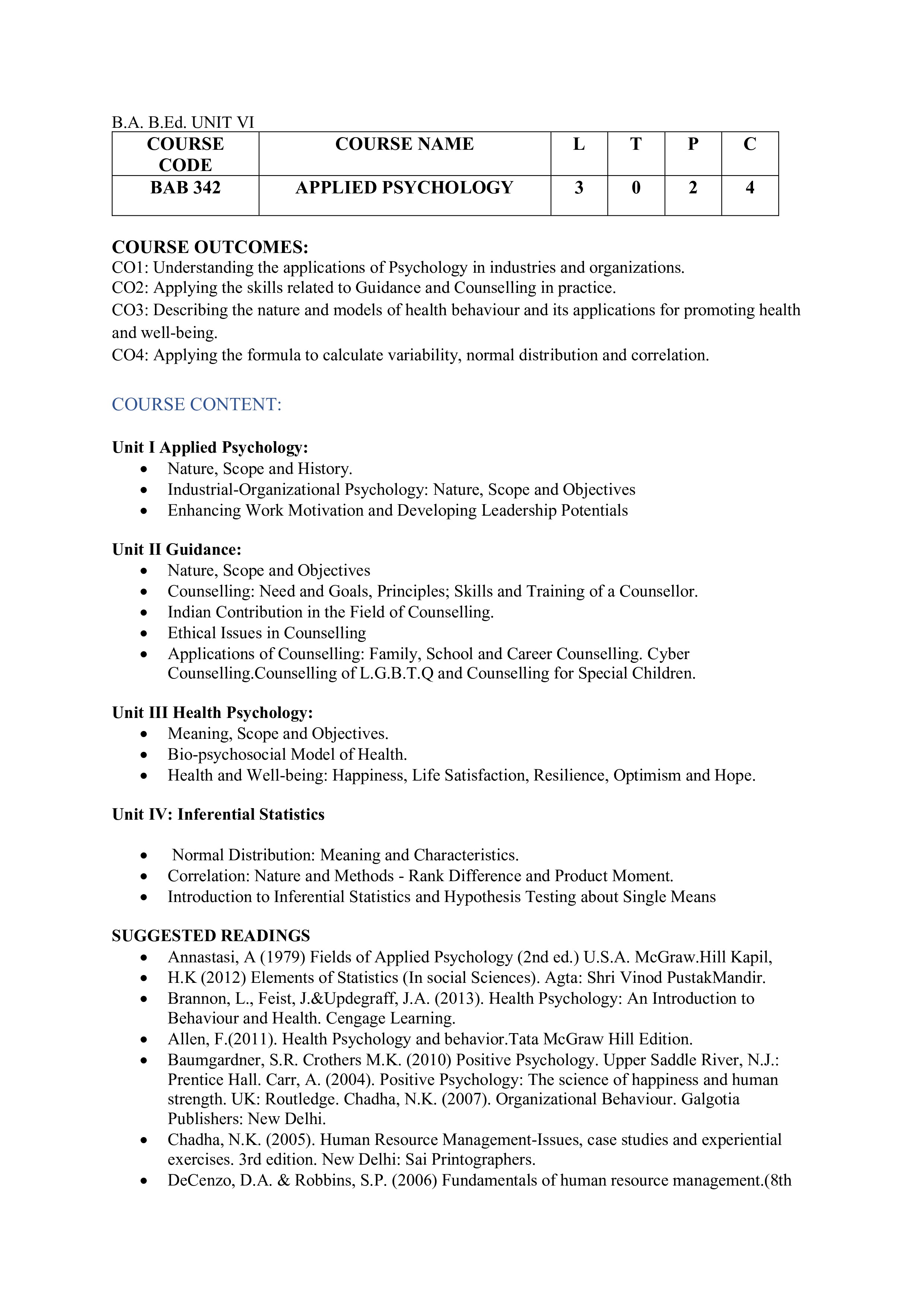
B.A. B.Ed. UNIT VI
|
COURSE CODE |
COURSE NAME |
L |
T |
P |
C |
|
BAB 342 |
APPLIED PSYCHOLOGY |
3 |
0 |
2 |
4 |
COURSE OUTCOMES:
CO1: Understanding the applications of Psychology in industries and organizations.
CO2: Applying the skills related to Guidance and Counselling in practice.
CO3: Describing the nature and models of health behaviour and its applications for promoting health and well-being.
CO4: Applying the formula to calculate variability, normal distribution and correlation.
COURSE CONTENT:
Unit I Applied Psychology:
· Nature, Scope and History.
· Industrial-Organizational Psychology: Nature, Scope and Objectives
· Enhancing Work Motivation and Developing Leadership Potentials
Unit II Guidance:
· Nature, Scope and Objectives
· Counselling: Need and Goals, Principles; Skills and Training of a Counsellor.
· Indian Contribution in the Field of Counselling.
· Ethical Issues in Counselling
· Applications of Counselling: Family, School and Career Counselling. Cyber Counselling.Counselling of L.G.B.T.Q and Counselling for Special Children.
Unit III Health Psychology:
· Meaning, Scope and Objectives.
· Bio-psychosocial Model of Health.
· Health and Well-being: Happiness, Life Satisfaction, Resilience, Optimism and Hope.
Unit IV: Inferential Statistics
· Normal Distribution: Meaning and Characteristics.
· Correlation: Nature and Methods - Rank Difference and Product Moment.
· Introduction to Inferential Statistics and Hypothesis Testing about Single Means
SUGGESTED READINGS
· Annastasi, A (1979) Fields of Applied Psychology (2nd ed.) U.S.A. McGraw.Hill Kapil,
· H.K (2012) Elements of Statistics (In social Sciences). Agta: Shri Vinod PustakMandir.
· Brannon, L., Feist, J.&Updegraff, J.A. (2013). Health Psychology: An Introduction to Behaviour and Health. Cengage Learning.
· Allen, F.(2011). Health Psychology and behavior.Tata McGraw Hill Edition.
· Baumgardner, S.R. Crothers M.K. (2010) Positive Psychology. Upper Saddle River, N.J.: Prentice Hall. Carr, A. (2004). Positive Psychology: The science of happiness and human strength. UK: Routledge. Chadha, N.K. (2007). Organizational Behaviour. Galgotia Publishers: New Delhi.
· Chadha, N.K. (2005). Human Resource Management-Issues, case studies and experiential exercises. 3rd edition. New Delhi: Sai Printographers.
· DeCenzo, D.A. & Robbins, S.P. (2006) Fundamentals of human resource management.(8th Ed). NY: Wiley.
· Dimatteo, M.R., & Martin L.R. (2011). Helath Psychology, India: Dorling Kindersely.
· Taylor, S.E. (2006) Health Psychology, 6th Edition. New Delhi: Tata McGraw Hill.
Practical
COURSE OUTCOMES:
CO1: acquainted with various kinds of psychological tests
CO2: conducting tests related to their theory paper.
Ø Work Motivation
Ø Organizational Climate Scale
Ø Counselling Need Inventory
Ø General Health Questionnaire
Ø Well-being Scale
Ø Resilience Scale
Ø Happiness Scale
Ø Leadership style scale/Questionnaire
Ø Life Style Questionnaire
Ø Project/Report Writing
Note: Students are to Conduct and report at least 3 practicals. The examiner will allot one practical at the time of examination
- Teacher: Dr. YOGITA SHARMA
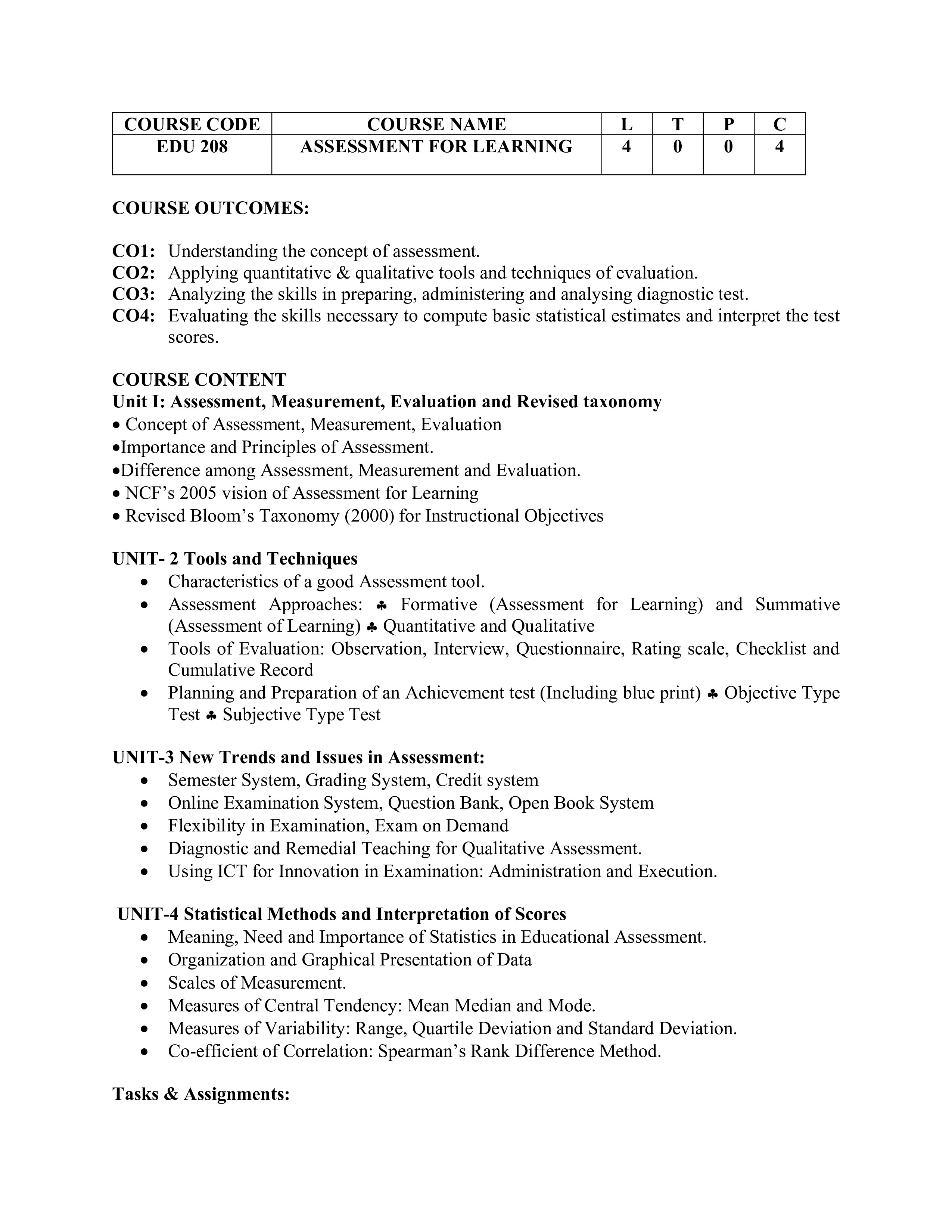
|
COURSE CODE |
COURSE NAME |
L |
T |
P |
C |
|
EDU 208 |
ASSESSMENT FOR LEARNING |
4 |
0 |
0 |
4 |
COURSE OUTCOMES:
CO1: Understanding the concept of assessment.
CO2: Applying quantitative & qualitative tools and techniques of evaluation.
CO3: Analyzing the skills in preparing, administering and analysing diagnostic test.
CO4: Evaluating the skills necessary to compute basic statistical estimates and interpret the test scores.
COURSE CONTENT
Unit I: Assessment, Measurement, Evaluation and Revised taxonomy
· Concept of Assessment, Measurement, Evaluation
·Importance and Principles of Assessment.
·Difference among Assessment, Measurement and Evaluation.
· NCF’s 2005 vision of Assessment for Learning
· Revised Bloom’s Taxonomy (2000) for Instructional Objectives
UNIT- 2 Tools and Techniques
· Characteristics of a good Assessment tool.
· Assessment Approaches: § Formative (Assessment for Learning) and Summative (Assessment of Learning) § Quantitative and Qualitative
· Tools of Evaluation: Observation, Interview, Questionnaire, Rating scale, Checklist and Cumulative Record
· Planning and Preparation of an Achievement test (Including blue print) § Objective Type Test § Subjective Type Test
UNIT-3 New Trends and Issues in Assessment:
· Semester System, Grading System, Credit system
· Online Examination System, Question Bank, Open Book System
· Flexibility in Examination, Exam on Demand
· Diagnostic and Remedial Teaching for Qualitative Assessment.
· Using ICT for Innovation in Examination: Administration and Execution.
UNIT-4 Statistical Methods and Interpretation of Scores
· Meaning, Need and Importance of Statistics in Educational Assessment.
· Organization and Graphical Presentation of Data
· Scales of Measurement.
· Measures of Central Tendency: Mean Median and Mode.
· Measures of Variability: Range, Quartile Deviation and Standard Deviation.
· Co-efficient of Correlation: Spearman’s Rank Difference Method.
Tasks & Assignments:
· Project on: Online Exam and On Demand Exam.
· Preparation of Diagnostic Test.
· Preparation of Achievement Test and Its Analysis.
· Preparation of Question Bank.
· Preparation of Cumulative Record of One Student during Teaching Practice.
SUGGESTED READINGS
· Aggarwal, Y.P. (2002). Statistical Methods: Concepts, Applications and Computation. New Delhi: Sterling Publishers Pvt. Limited.
· Anastasi, A. (1976). Psychological Testing. New York: McMillan Publishing Co., Inc.
· Asthana, B. (2008). Measurement and Evaluation in Psychology and Education. Agra: Agrawal Publications.
· Bhargava, M. and Mathur, M. (2005).Psychometrics and Statistical Applications in Educational and Behavioural Sciences. Agra: H. P. Bhargava Book House.
· Choube. P. S (1998). A Guide to Psychology Experiments and Statistical Formulas. Agra: Vinod Pustak Mandir.
· Gupta Rainu (2020) Measurement, Evaluation and assessment for Learning, Shipra Publications, New Delhi
· Guilford, J.P. and Fruchter, B. (1970).Fundamental Statistics in Psychology and Education. New York: McMillan Publishing Co., Inc.
· Mangal, S.K. (2002).Statistics in Psychology and Education. New Delhi: Prentice Hall of India.
- Faculty: Dr. YOGITA SHARMA
COURSE OUTCOMES:
CO1. Understanding the ways and importance of personal grooming.
CO2. Analyzing the ways to perform effectively in group discussions.
CO3. Applying the techniques to make good resume and prepare effectively for interview.
CO4. Applying good communication skills and developing confidence.
UNIT IPERSONALITY AND PERSONAL GROOMING
- Understanding Personality
- Definition and Meaning of Personality
- Types of Personality
- Components of Personality
• Determinants or Personalty
• Assessment of Personality Grooming Self
• Dress for success
- Make up & skin care
- Hair care & styles for formal look
- Art of accessorizing
- Oral Hygiene
UNIT II INTERVIEW PREPARATION AND GROUP DISCUSSION
- Meaning and Types of Interview[ Face to Face, Telephonic, Video]|
- Interview procedure [Opening, Listening, Closure]
- Preparation for Interview
- Resume Writing
- LinkedIn Etiquette
- Meaning and methods of Group Discussion
- Procedure of Group Discussion.
Group Discussion simulation
Group discussion common error
UNIT III BODY LANGUAGE AND BEHAVIOUR
- Concept of human behavior
- Individual and group behavior
- Developing Self-Awareness
- Behaviousand body language
Dimensions of body language: Proxemics Haptics Oculesies Paralanguage Kinesics Sign Language Chromatics Chronemics Olfastica
- Cultural differences in Body Language
- Business Etiquette & Body language
- Body Language in the Post Corona Era
- Virtual Meeting Etiquette
• Social Media Etiquette
UNIT IV ART OF GOOD COMMUNICATION
• Communication Process
Verbal and Non-verbal communication
• 7 € of effective communication
• Barriers to communication
- Paralinguistics Pitch Tone Volume Vocabulary Word stress Pause
- Types of communication Assertive Aggressive Passive Aggressive
Listenine Skills
- Questioning Skills
- Art of Small Talk
- Email Writing
Suggested Readings:
- Cloninger, S.C., "Theories of Bersenelity:
This course is designed to develop a student’s overall personality, communication ability, and professional readiness, focusing on both personal grooming and effective interaction skills required in real-life and workplace situations. It aims to build confidence, improve self-presentation, and prepare students for interviews, group discussions, and professional communication.
The first unit, Personality and Personal Grooming, introduces the concept of personality by explaining its meaning, types, components, and determinants. It helps students understand how personality is shaped by both internal traits and external influences. The unit also focuses on self-assessment, encouraging students to evaluate their own strengths and areas for improvement. A major part of this unit is grooming, which includes dressing professionally, maintaining proper hygiene, and presenting oneself confidently. Topics such as dress for success, makeup and skincare, hair care, accessorizing, and oral hygiene emphasize the importance of appearance in creating a positive first impression.
The second unit, Interview Preparation and Group Discussion, equips students with the skills needed to succeed in professional selection processes. It explains different types of interviews, such as face-to-face, telephonic, and video interviews, along with the stages of an interview like opening, listening, and closing. Students learn how to prepare effectively by researching, practicing responses, and presenting themselves confidently. Resume writing and LinkedIn etiquette are also included to help students build a strong professional profile. The unit further covers group discussions, explaining their meaning, methods, procedures, and common errors, while also providing practice through simulations to improve performance.
The third unit, Body Language and Behaviour, focuses on understanding human behavior and the role of non-verbal communication. It helps students develop self-awareness and understand both individual and group behavior. The unit explains various dimensions of body language such as eye contact, gestures, personal space, tone of voice, and physical touch. It also highlights cultural differences in body language and teaches appropriate business etiquette. Special attention is given to modern communication contexts, including virtual meeting etiquette and social media behavior, especially in the post-pandemic era.
The fourth unit, Art of Good Communication, develops essential communication skills. It explains the communication process and the difference between verbal and non-verbal communication. Students learn the “7 Cs” of effective communication—clarity, conciseness, correctness, completeness, courtesy, concreteness, and consideration. The unit also discusses barriers to communication and how to overcome them. Important aspects like tone, pitch, vocabulary, and pauses (paralinguistics) are covered. It introduces different communication styles such as assertive, aggressive, and passive, along with listening and questioning skills. Finally, it includes practical aspects like small talk and email writing.
Overall, this course aims to transform students into confident, well-groomed, and effective communicators who are ready to face academic, social, and professional challenges successfully.
- Teacher: Riya Vardhan Saxena
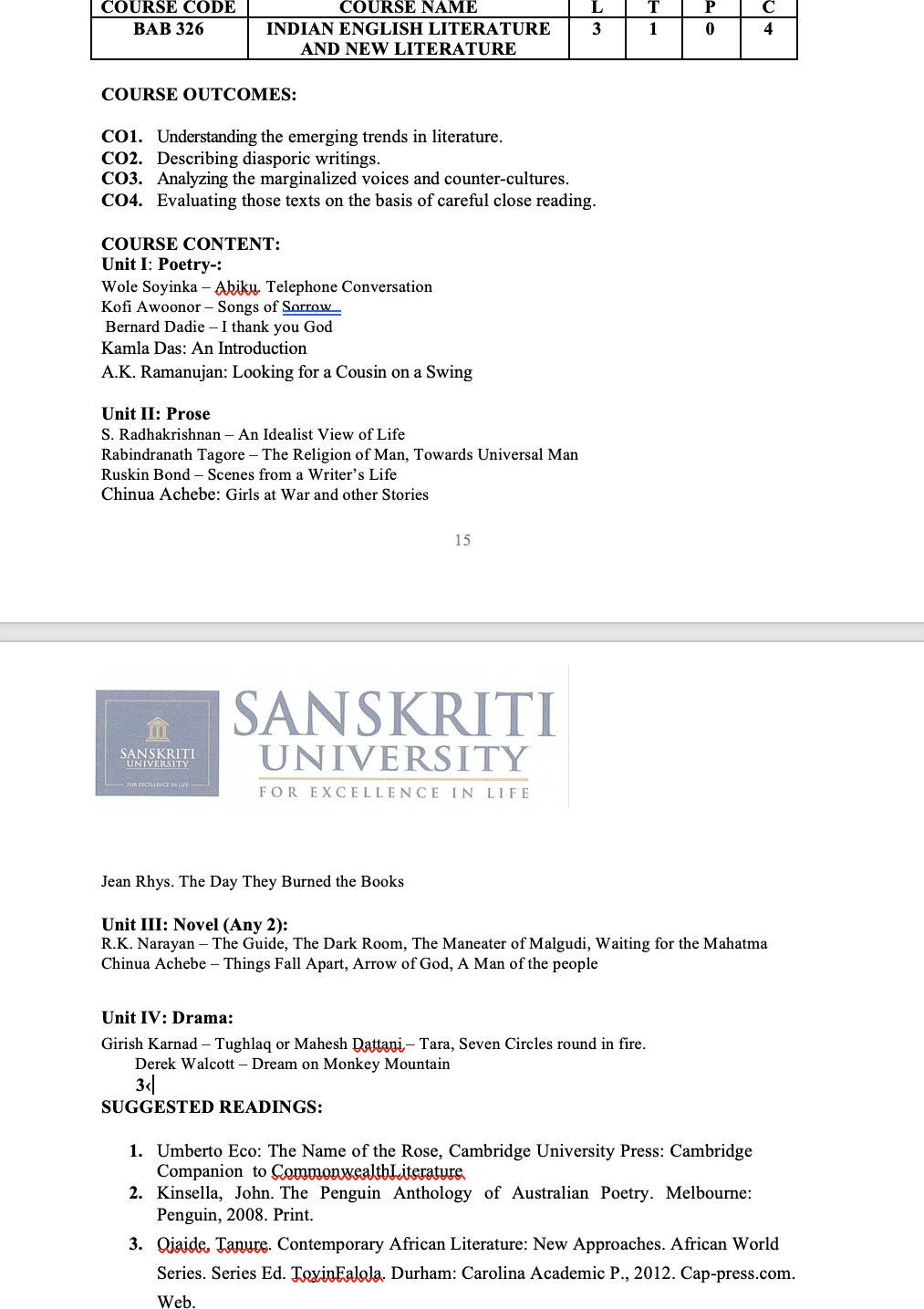
This course is designed to introduce students to modern and postcolonial literature, focusing on diverse voices, cultures, and emerging literary trends from across the world. It aims to develop a deeper understanding of how literature reflects social change, identity, and cultural experiences. One of the main objectives of the course is to help students understand the new directions in literature, especially those that move beyond traditional Western perspectives and include global, diasporic, and marginalized voices. It also trains students to analyze texts carefully through close reading, encouraging them to interpret meaning, themes, and literary techniques in a detailed and critical way.
In Unit I, the poetry section presents a wide range of voices from African and Indian writers, such as Wole Soyinka, Kofi Awoonor, Kamala Das, and A. K. Ramanujan. These poems explore themes like identity, race, colonialism, tradition, and personal experience. For example, Soyinka’s poems deal with African beliefs and racial discrimination, while Kamala Das writes about personal identity and gender. This unit helps students understand how poetry expresses both individual emotions and cultural realities.
Unit II focuses on prose writings, including essays and short stories by important thinkers and writers such as Sarvepalli Radhakrishnan, Rabindranath Tagore, Ruskin Bond, Chinua Achebe, and Jean Rhys. These works deal with philosophical ideas, human values, cultural identity, and everyday life. Students are introduced to diasporic writing, which reflects the experiences of people living away from their homeland, often dealing with issues of belonging and identity.
In Unit III, the focus shifts to novels, where students study selected works of R. K. Narayan and Chinua Achebe. These novels portray life in postcolonial societies, highlighting social change, tradition vs modernity, and cultural conflicts. Through these texts, students learn to analyze characters, themes, and narrative techniques while understanding the social and historical contexts of the works.
Unit IV deals with drama, featuring playwrights like Girish Karnad, Mahesh Dattani, and Derek Walcott. These plays address important issues such as politics, gender, identity, and social injustice. For instance, Karnad’s Tughlaq explores political idealism and failure, while Dattani’s plays focus on marginalized voices and hidden social realities.
Overall, this course encourages students to explore literature as a reflection of diverse cultures, identities, and social issues. It develops critical thinking by focusing on marginalized voices, counter-cultures, and global perspectives. By the end of the course, students gain the ability to understand complex literary texts, appreciate different cultural viewpoints, and analyze literature in a thoughtful and meaningful way.
- Teacher: Riya Vardhan Saxena
UNIT 1:
The World in the pre-World
War I period:
Defining contemporary history – Nazism and Fascism, Unification of Italy - the rise of nationalism, Nation building in Italy, Steps and Process of Unification, Mussolini's role in the unification of Italy.
Unification of Germany - the process of Unification, supporting Causes and Barriers., Role of Otto von Bismarck in the unification of Germany.
UNIT II:
The First World War 1914-1918:
Beginning and the course of the First World War – Background, Causes, and Result of War. the Paris Peace Conference and Treaty of Versailles, League of Nations, The Inter-War Period of Economic Depression. Russian Revolution- Causes, steps, effects, Rise of Soviet Russia under Stalin.
UNIT III:
The Second World War:
The Second World War – Background, Causes, and effects on the world. End of colonialism.
UNIT IV:
Cold War:
emergence of two groups, the Causes of the Cold War, the development of the Cold War, the End of the Cold War, the Effects on the world, and American dominance, Due to the end of the Cold War. The third world - Non-aligned Group.
- Teacher: Pushpendra Kumar