FOR EXCELLENCE IN LIFE
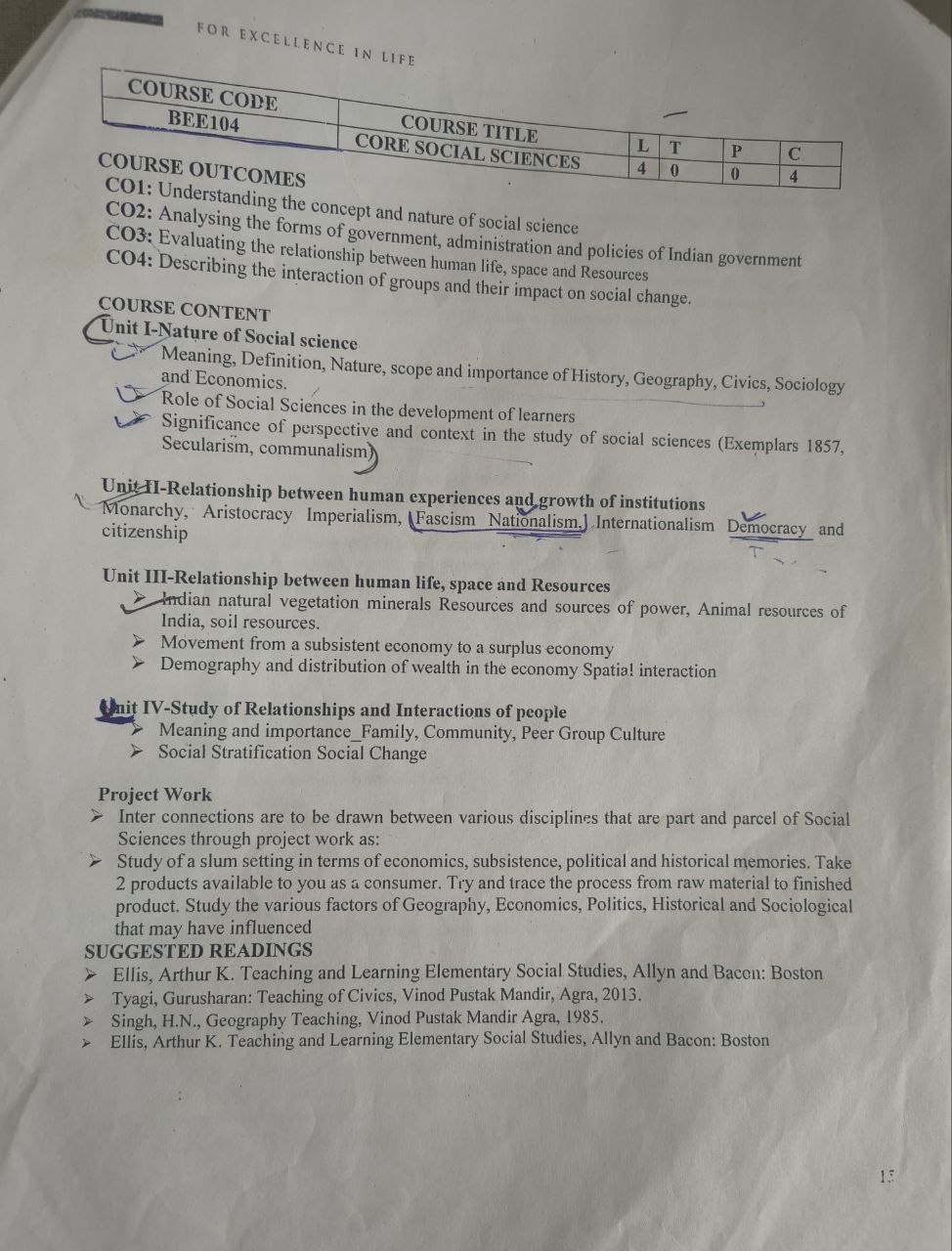
| COURSE CODE | COURSE TITLE | L | T | P | C |
|---|---|---|---|---|---|
| BEE104 | CORE SOCIAL SCIENCES | 4 | 0 | 0 | 4 |
COURSE OUTCOMES
- CO1: Understanding the concept and nature of social science
- CO2: Analysing the forms of government, administration and policies of Indian government
- CO3: Evaluating the relationship between human life, space and Resources
- CO4: Describing the interaction of groups and their impact on social change
COURSE CONTENT
Unit I – Nature of Social Science
Meaning, Definition, Nature, scope and importance of History, Geography, Civics, Sociology and Economics
Role of Social Sciences in the development of learners
Significance of perspective and context in the study of social sciences (Exemplars: 1857, Secularism, Communalism)
Unit II – Relationship between human experiences and growth of institutions
Monarchy, Aristocracy, Imperialism, Fascism, Nationalism, Internationalism
Democracy and citizenship
Unit III – Relationship between human life, space and Resources
Human natural vegetation, minerals, resources and sources of power, animal resources of India, soil resources
Movement from a subsistent economy to a surplus economy
Demography and distribution of wealth in the economy, spatial interaction
Unit IV – Study of Relationships and Interactions of people
Meaning and importance of Family, Community, Peer Group, Culture
Social Stratification, Social Change
- Teacher: Nidhi Singh
|
COURSE CODE |
COURSE TITLE
|
L |
T |
P |
C |
|
BEE 105 |
CORE NATURAL SCIENCES
|
4 |
0 |
0 |
4 |
COURSE OUTCOMES
CO1: Defining and recognize the concept, relation, classification, property, law of natural phenomenon.
CO2: Computing length, mass and time, density, pressure, work and energy; weight; gravitation; heal and temperature;
CO3: Explaining the states of matter; properties of magnets; electricity; refraction and dispersion.
CO4: Classifying and explaining living and non-living; classification of living world; germination of seeds; life processes of various phenomenon of nature, as respiration, digestion, reproduction, photosynthesis, transportation and interdependence of plants and animals.
UNIT-I
Matter
· Scientific Method
· Classification of Matter
· Properties of matter
· Scientific facts, concepts, and relationships
· Scientific theories and Laws
UNIT-II
Measurement of Length, Mass and Time
· Work and energy, pressure, weight
· Falling of bodies, gravitation, heat and temperature, states of matter
· Properties of magnet, electricity, refraction and dispersion.
UNIT III
Physical and Chemical Changes, Separation of Mixtures
· Atoms and molecules
· Metals and non-metals
· Oxides, acids, bases and salts
· Air and combustion, Water: hard and soft
UNIT IV
Living and Non-Living
· Classification of living world
· Germination of seeds
UNIT-V
Life processes
· Respiration
· Digestion,
· Reproduction,
· Photosynthesis
· Transportation
· Phenomena
· Interdependence of plants and animals
PROJECT-3
Not More than One from Each Area
· P1-Natural Phenomena
· P2 -Environment and Adaptation
· P3-Technology
· P4-Health
SUGGESTED READINGS
· Jennings, J. (1980). The Young Scientist Investigates. Booki DII, Oxford University Press: London.
· Keetow, W. T. & Gould, J. L. 1986). Biological Science. W. W. Norton: New York.
· Kulsreshta, S. P. (n.d.): Teaching of Biology, Loyal Book Depot, Meerut.
· Nelson, R. & Lootoian. B. (n.d.). Fundamental Concepts of Biology.John Wiley &Sons: New York.
·
Rawat, D.S. . Vigyan Shikshan. Agrawal Publication, Agra.
· Singh, V (n. d.): A Text Book of Botany
· Taylor, D. J. (n. d.). Biological Science
· UNESCO (1979). New UNESCO Source Book for Science Teaching. University Press (India) Ltd: India, 1979.
- Teacher: BHOPAL RAWAT