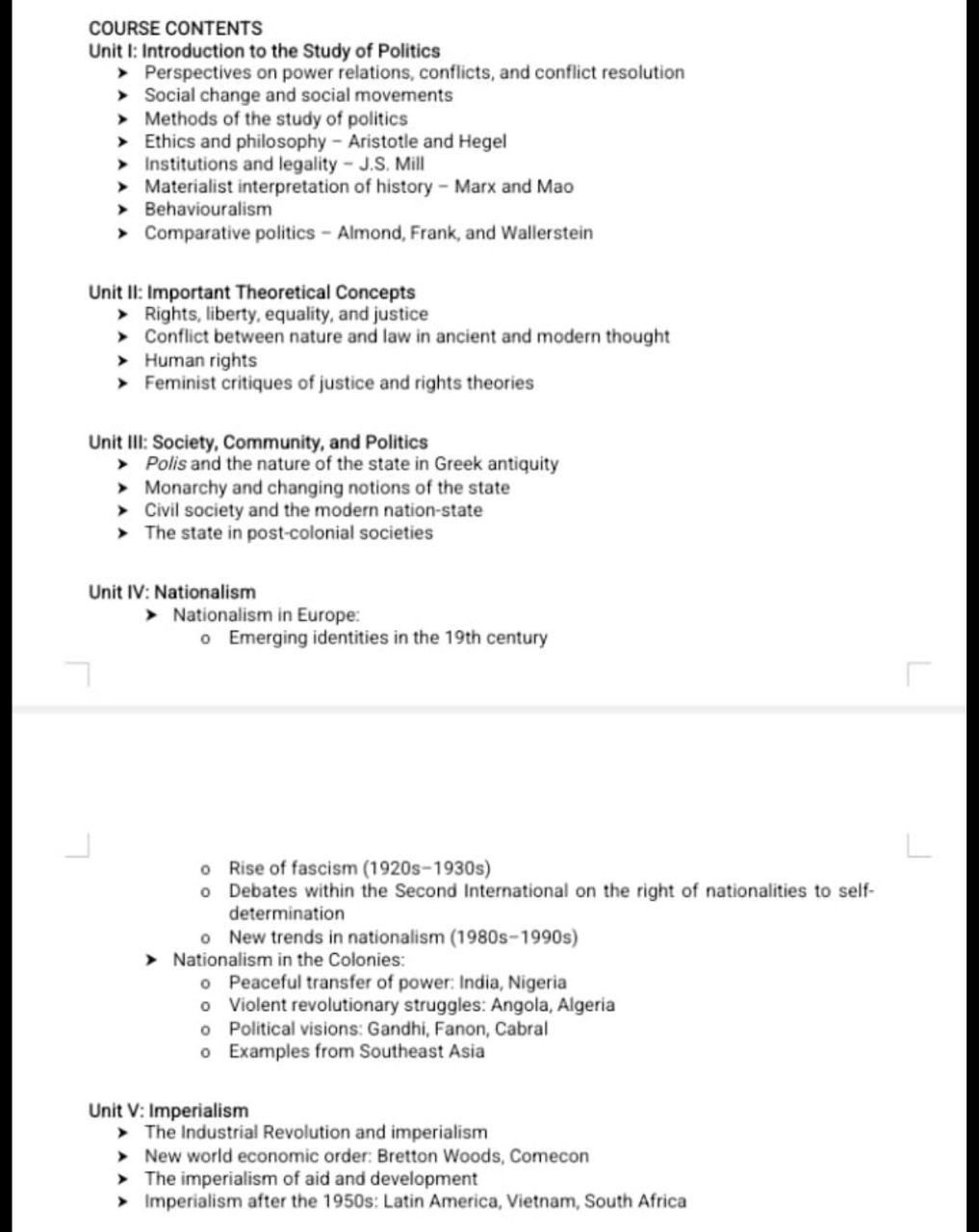
| COURSE CODE | COURSE TITLE | L | T | P | C |
|---|---|---|---|---|---|
| BEE 224 | POLITICAL SCIENCE | 4 | 0 | 0 | 4 |
Unit I: Introduction to the Study of Politics
- Perspectives on power relations, conflicts, and conflict resolution
- Social change and social movements
- Methods of the study of politics
- Ethics and philosophy – Aristotle and Hegel
- Institutions and legality – J.S. Mill
- Materialist interpretation of history – Marx and Mao
- Behaviouralism
- Comparative politics – Almond, Frank, and Wallerstein
Unit II: Important Theoretical Concepts
- Rights, liberty, equality, and justice
- Conflict between nature and law in ancient and modern thought
- Human rights
- Feminist critiques of justice and rights theories
Unit III: Society, Community, and Politics
- Polis and the nature of the state in Greek antiquity
- Monarchy and changing notions of the state
- Civil society and the modern nation-state
- The state in post-colonial societies
Unit IV: Nationalism
- Nationalism in Europe:
- Emerging identities in the 19th century
- Rise of fascism (1920s–1930s)
- Debates within the Second International on the right of nationalities to self-determination
- New trends in nationalism (1980s–1990s)
- Nationalism in the Colonies:
- Peaceful transfer of power: India, Nigeria
- Violent revolutionary struggles: Angola, Algeria
- Political visions: Gandhi, Fanon, Cabral
- Examples from Southeast Asia
Unit V: Imperialism
- The Industrial Revolution and imperialism
- New world economic order: Bretton Woods, Comecon
- The imperialism of aid and development
- Imperialism after the 1950s: Latin America, Vietnam, South Africa
- Teacher: Nidhi Singh
Course Code | Course Title | L | T | P | C |
BEE 212 | Structure and Management of Elementary Schools in India | 4 | 0 | 0 | 4 |
Course Outcomes:
CO1: Understanding the status of elementary education in India.
CO2: Appreciating the organisational structure of elementary education.
CO3: Analysing functions of institutions in administration and management of elementary education.
CO4: Evaluating decentralisation of administration and management of elementary education.
Unit I: Introduction to Elementary Education
· Course objectives of elementary and upper elementary education
· Historical perspective of elementary education in India (Pre- and post-independence)
· Constitutional provisions and centre-state relationship in India
· Recommendations of various committees and commissions:
o Secondary Education Commission
o Kothari Commission
o Iswari Bhai Patel Committee
o National Policy on Education (NPE) 1986 and Programme of Action (POA) 1992
o Ramamurthy Committee
o Janardhan Reddy Committee
o Yashpal Committee
o National Education Policy (NEP) 2020
Unit II: Structure of Elementary Education in India
· Governance and administration of elementary education in India
· Universalisation of Elementary Education (UEE)
· District Elementary Education Programme (DEEP) and Right to Education (RTE) Act
· EFA Global Monitoring Report (UNESCO, 2005:142)
· Education reform and reform-oriented state policies
· Alternative school types:
o National Institute of Open Schooling (NIOS)
o International schools
o Islamic schools (Madrasahs)
o Autonomous schools
Unit III: Educational Management at Elementary Level
National Level:
· Ministry of Education (formerly MHRD)
· Central Advisory Board of Education (CABE)
· NCERT, RIE, NIEPA, NCTE, CIET
State Level:
· Ministry of School Education
· Directorate of School Education
· State Boards of Education
· SCERT, SSA, SIET, SRC, SIEMAT
District Level:
· District Education Administration – DEO, Dy. EO (Zilla Parishad), DPO (SSA)
Sub-District Level:
· URC/BRC/BEO
· CRC representatives, innovative teachers
Unit IV: Programmes and Implementation Strategies in Elementary Education
Centrally Sponsored Schemes
· Assumptions, implementation strategies, and impact of:
o IEDC
o SOPT
o PMOST
o OBB
o MLL
o DPEP
o EGS and AIE
o KGBV
State Projects
· BEP, APEP, UPBEP, Lok Jumbish
· ABL, Nali Kali, Mahila Samakhya
· Shiksha Karmi, AIEP, Learning Enhancement Programmes
Major Initiatives:
· Sarva Shiksha Abhiyan (SSA):
o Objectives, focus areas, implementation strategies, and impact on quality enhancement
· Mid-Day Meal Scheme (MDM):
o Objectives, implementation, and impact on enrolment, retention, and learning outcomes
Unit V: Inclusive Education at the Elementary Level
· Concept, need, and importance of inclusive education
· Perspectives on inclusive education:
o Human rights
o Diversity
o Social justice
o Equity and equality
· Shift from segregated and integrated education to inclusive education
· Recommendations from commissions and committees on inclusive practices
· Challenges in bringing all children to the same school, particularly:
o Children with disabilities
o Children from weaker social, cultural, and economic backgrounds
Sessional Activities:
1. Prepare a status report on elementary education in a district (access, enrolment, participation, learning achievement).
2. Observe and report on the implementation of any one programme for quality improvement in elementary education.
3. Read and discuss philosophies and practices of elementary education advocated by different educationists.
4. Prepare a short write-up on “Initiatives to Bridge Gender Gap in Elementary Education” and discuss.
5. Conduct a survey on elementary school teachers’ opinions on inclusive education policies.
6. Visit one or two local elementary schools to observe the Mid-Day Meal Scheme and/or inclusive environment and report with suggestions.
7. Compare national and international elementary education curricula and discuss.
8. Analyze and compare the curriculum of any two Indian states (grade-wise or subject-wise).
9. View and reflect on videos/films on elementary education issues (e.g., Savitribai Phule, Lilkee, India Untouched, The Darker Side of India, talks by Abdul Kalam, Kailash Satyarthi, Malala, etc.).
Suggested Readings:
Ø Government of India (2005). National Plan of Action for Children, 2005. Department of Women and Child Development, New Delhi.
Ø Report of the Education Commission (1964–66).
Ø Report of the National Commission on Teachers (1983–85).
Ø Report of the Delors Commission, UNESCO, 1996.
Ø National Policy on Education, 1986/1992.
Ø National Curriculum Framework for School Education, 2005.
Ø Pathak, Avijit (2002). Social Implications of Schooling. Rainbow Publishers: Delhi.
Ø Development in Practice – Primary Education in India. The World Bank: Washington DC, 1997. Allied Publishers: New Delhi.
Ø Prakash, V. (1997, Ed.). Teacher Empowerment and School Effectiveness at Primary Stage. NCERT: New Delhi.
Ø NEUPA (2014). India: Education for All – Towards Quality with Equity. NEUPA/MHRD: New Delhi.
- Teacher: Priyanka Gautam
|
COURSE CODE |
COURSE TITLE |
L |
T |
P |
C |
|
BEE 208 |
LANGUAGE ACROSS THE CURRICULUM |
3 |
0 |
0 |
3 |
COURSE OUTCOMES
CO1: Understanding the importance of multilingualism for a teacher.
CO2: Developing a positive attitude toward different languages.
CO3: Developing soft skills.
CO4: Understanding the need for effective reading and writing.
Unit I: Concept of Language
- Base and facets of language
- Diversity of language
- Theories of language learning
- Barriers in using a language
- Social, physical, and linguistic errors in language usage
Unit II: Communication
- Meaning and concept of communication
- Process of communication
- Types of communication
- Communication skills:
- Sender
- Message
- Receiver
- Medium
- Analysis
Unit III: Self-Development Skills and Life Skills
- Key Personal and Social Skills:
- Adaptability
- Accountability
- Responsibility (personal, workplace & community)
- Management skills
- Social responsibility skills
- Human relation skills
- Emotional skills
- Life Skills:
- Self-awareness
- Empathy
- Interpersonal communication
- Critical thinking
- Creative thinking
- Decision-making
- Problem-solving
Unit IV: Developing Reading and Writing Skills
- Strategies for effective reading
- Mechanism of reading
- Loud reading and silent reading
- Writing processes and strategies for children
- Developing listening skills
- Constructive Skills:
- Engaging
- Exploring
- Explaining
- Elaborating
- Evaluating
Unit V: Classroom Discourse
- Importance of oral language
- Discussion as a tool for learning
- Questions as a tool for learning
- Role of the teacher in classroom discourse
Suggested Readings / References:
Ø Batra, P. (Ed.). (2010). Social Science Learning in Schools: Perspective and Challenges. New Delhi: Sage Publications.
Ø Dewey, J. (1997). My Pedagogic Creed. School Journal, Vol. 54.
Ø Bruner, J. (1996). In the Culture of Education. Cambridge: Harvard University Press.
o Chapter 2: Folk Pedagogy (pp. 44–65)
- Teacher: BHOPAL RAWAT
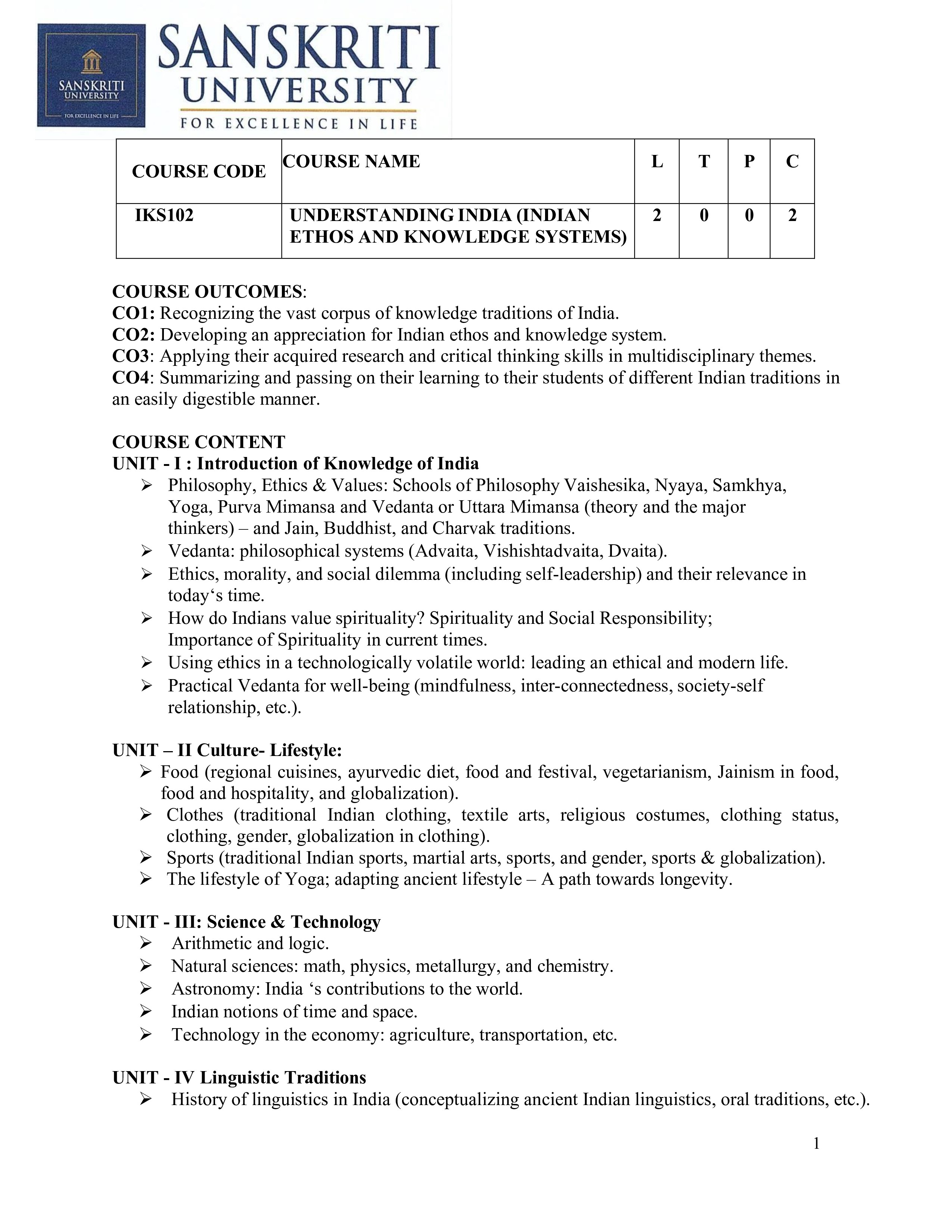
|
COURSE CODE |
COURSE NAME
|
L |
T |
P |
C |
|
IKS102 |
UNDERSTANDING INDIA (INDIAN ETHOS AND KNOWLEDGE SYSTEMS) |
2 |
0 |
0 |
2 |
COURSE OUTCOMES:
CO1: Recognizing the vast corpus of knowledge traditions of India.
CO2: Developing an appreciation for Indian ethos and knowledge system.
CO3: Applying their acquired research and critical thinking skills in multidisciplinary themes.
CO4: Summarizing and passing on their learning to their students of different Indian traditions in an easily digestible manner.
COURSE CONTENT
UNIT - I : Introduction of Knowledge of India
Ø Philosophy, Ethics & Values: Schools of Philosophy Vaishesika, Nyaya, Samkhya, Yoga, Purva Mimansa and Vedanta or Uttara Mimansa (theory and the major thinkers) – and Jain, Buddhist, and Charvak traditions.
Ø Vedanta: philosophical systems (Advaita, Vishishtadvaita, Dvaita).
Ø Ethics, morality, and social dilemma (including self-leadership) and their relevance in today‘s time.
Ø How do Indians value spirituality? Spirituality and Social Responsibility; Importance of Spirituality in current times.
Ø Using ethics in a technologically volatile world: leading an ethical and modern life.
Ø Practical Vedanta for well-being (mindfulness, inter-connectedness, society-self relationship, etc.).
UNIT – II Culture- Lifestyle:
Ø Food (regional cuisines, ayurvedic diet, food and festival, vegetarianism, Jainism in food, food and hospitality, and globalization).
Ø Clothes (traditional Indian clothing, textile arts, religious costumes, clothing status, clothing, gender, globalization in clothing).
Ø Sports (traditional Indian sports, martial arts, sports, and gender, sports & globalization).
Ø The lifestyle of Yoga; adapting ancient lifestyle – A path towards longevity.
UNIT - III: Science & Technology
Ø Arithmetic and logic.
Ø Natural sciences: math, physics, metallurgy, and chemistry.
Ø Astronomy: India ‘s contributions to the world.
Ø Indian notions of time and space.
Ø Technology in the economy: agriculture, transportation, etc.
UNIT - IV Linguistic Traditions
Ø History of linguistics in India (conceptualizing ancient Indian linguistics, oral traditions, etc.).
Ø Language as Culture: Evolution of Languages over the years & language as building blocks to different cultures and society
Ø Language: Identity, culture, and History.
SUGGESTIVE PRACTICUM
Ø Practicum will include organization of day trips that help student teachers watch events relating to visual and performing art; activities that enable student teachers to identify and record through photos, videos, etc. the elements of ancient architecture still existing in the city around them; organization of Individual and group presentations based on themes such as Polity, Law and Economy etc., organization of a ‗Knowledge of India‘ day in the institution to celebrate the culture (food, clothes, etc.) that they would have been explored in lectures and tutorials; interactions with family members, elders, neighbors, and other members of society about the evolution of local systems and economy etc.
SUGGESTED READINGS
Ø Radhakrishnan, S., & Moore, C. A. (Eds.). (1957). A Sourcebook in Indian Philosophy. Princeton University Press.
Ø Isaeva, N. V. (1993). Shankara and Indian Philosophy. State University of New York Press.
Ø Achaya, K. T. (1998). Indian Food: A Historical Companion. Oxford University Press.
Ø Staal, F. (2008). Discovering the Vedas: Origins, Mantras, Rituals, Insights. Penguin Books.
Ø Bhattacharya, N. N. (2010). Indian Philosophy (Vols. 1 & 2). Motilal Banarsidass.
Ø Rao, S. R. (1993). Indian Philosophy and Religion. Bharatiya Vidya Bhavan.
- Teacher: Dr. YOGITA SHARMA
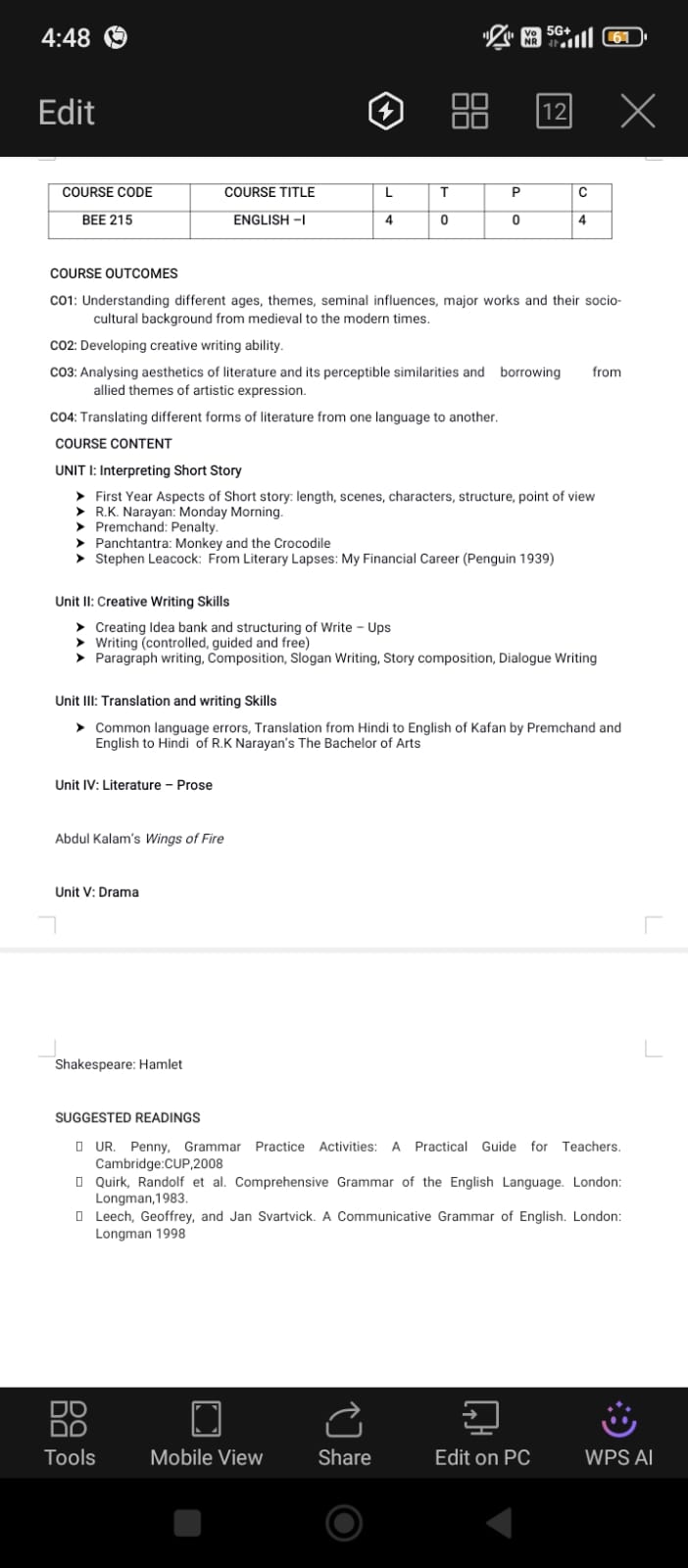
COURSE OUTCOMES
C01: Understanding different ages, themes, seminal influences, major works and their socio-
cultural background from medieval to the modern times.
CO2: Developing creative writing ability.
СО3: Analysing aesthetics of literature and its perceptible similarities and borrowing from
allied themes of artistic expression.
CO4: Translating different forms of literature from one language to another.
This course is designed to provide students with a comprehensive understanding of literature from the medieval to the modern period, focusing on its themes, historical context, and socio-cultural influences. It aims to develop students’ analytical and creative abilities by engaging them with a variety of literary forms, including short stories, prose, and drama.
The course introduces key elements of short story writing such as structure, characterization, point of view, and narrative technique through works by renowned authors like R.K. Narayan, Premchand, and Stephen Leacock, along with traditional tales from the Panchtantra. It also emphasizes the development of creative writing skills, enabling students to express their ideas effectively.
In addition, the course focuses on translation and language skills by addressing common language errors and providing practice in translating literary texts between Hindi and English. Students are also exposed to significant prose works such as A.P.J. Abdul Kalam’s Wings of Fire, which offers inspiration and insight into personal and professional growth.
The study of drama is enriched through Shakespeare’s Hamlet, helping students understand dramatic structure, characterization, and thematic depth. Overall, the course seeks to enhance literary appreciation, critical thinking, and communication skills, while fostering an understanding of the interconnectedness of literature and other forms of artistic expression.
- Teacher: Riya Vardhan Saxena